

Almost everything written about selling a house in Illinois is a cost calculator wearing a guide's clothes. Cost is the question that converts for a national marketplace, so cost is what gets written. It is a fair question with a real answer, which is why it lives in its own piece: what it really costs to sell a house in Illinois. Read that one for the money.
This one is the other half, and it is the half that decides whether you close on time: the order of the transaction and the paperwork inside it. If you would rather hand the sequence to someone who runs it every week, that is what listing your home with a Tri-Cities agent is for.
The whole sequence on one screen. Everything below is detail.
Steps 4 through 9 run 4 to 6 weeks on average, very dependent on the situation. Steps 1 to 3 take as long as they take, because that depends on the house and the market, not a deadline.
The main document is the Residential Real Property Disclosure Report. You answer a fixed set of questions about the property's condition based on what you actually know. The standard set by the Residential Real Property Disclosure Act is knowledge, not perfection: you are not certifying the house is flawless, and you are not required to hunt for defects you have never noticed. You are required to answer honestly about what you do know.
Alongside it sits radon. The Illinois Radon Awareness Act requires sellers to give residential buyers radon information before the contract is signed, and if the house has been tested or mitigated that comes out here. The Illinois Department of Public Health explains what readings mean. Homes built before 1978 also carry the federal lead paint disclosure.
Know about a real problem? Disclose it. A known defect that surfaces at inspection costs you a concession. The same defect found after closing, when you answered no on the form, is a far worse problem. Disclosing early also lets you fix it on your own schedule rather than under a deadline.
The method matters more than any number, so here is the method. Price comes from recent comparable sales of similar homes nearby, adjusted for condition, updates and location, then checked against what is competing with you now. Not what you paid, not what you need to clear, and not an automated estimate that has never been inside your house.
Then the market tells you whether you were right, fast. Strong showing traffic with no offers usually means the house is priced ahead of its condition. No traffic at all means it is priced ahead of the market. An early reduction reads as responsive; a series of small ones over months reads as a house with something wrong with it, whether or not anything is.
Almost every buyer meets your house on a screen first, so the photos are the showing before the showing. Everything you plan to do to the house gets done before the photographer arrives: declutter until it feels slightly bare, clean past the point you would for guests, handle light bulbs and touch-up paint, tidy the front, and put away anything you would not want a stranger studying.
Then make it easy to see. Restricted showing windows cost you buyers, and the one you turned away on a Tuesday does not always come back.
An accepted offer in Illinois begins a negotiation rather than ending one. A contract is price, yes, but also earnest money, the closing date, the mortgage contingency and its deadline, the inspection window, included personal property, and whether the buyer must sell something first. A clean offer slightly lower will often serve you better than a higher one carrying four contingencies and a distant closing date. Read the terms, not the top line.
This is the step that surprises sellers from other states, and it sets the tone for everything after it. Once the contract is signed, both sides have five business days for their attorneys to review it. Terms can be modified during that window, and the contract can be cancelled outright. Business days means the weekend does not count, so a Friday contract gives you the following Friday.
Most deals do not die here. They stall here. Someone is out of the office, someone has not sent the disclosure report, someone takes three days to answer a one-line email. The fix is unglamorous: have your attorney engaged before you list, and answer requests the day they arrive.
The buyer inspects, then asks for something. It resolves in one of three shapes, and it is worth deciding which you prefer before the request arrives. You can do the work, which suits real safety or structural items. You can offer a credit at closing, usually cleaner: no contractor scheduling against your closing date, and the buyer picks who does the work. Or you can decline, a real option when the request is a wish list rather than a defect, particularly on an older home sold as-is.
What you are protecting is the closing date. A repair agreed in the last ten days is a repair that can delay closing.
Three things run in parallel after inspection, and each can hold up a closing on its own.
| What | How it holds up a closing | When to start it |
|---|---|---|
| Appraisal | Comes in under contract price, so the financing gap gets renegotiated or covered. | Lender orders it once attorney review settles |
| Title search | Old liens, a paid mortgage never released, an estate in the chain, a name spelled differently on an old deed. | Open title the week you go under contract |
| Plat of survey | No current survey, or one showing a fence, shed or drive over a line. | Order at contract, earlier if it is old |
| Payoff letter | Lender takes days to issue it, and the figure must be exact. | Request two to three weeks out |
| Municipal items | Some towns want an inspection, water final or transfer stamp first. | Ask your attorney at contract |
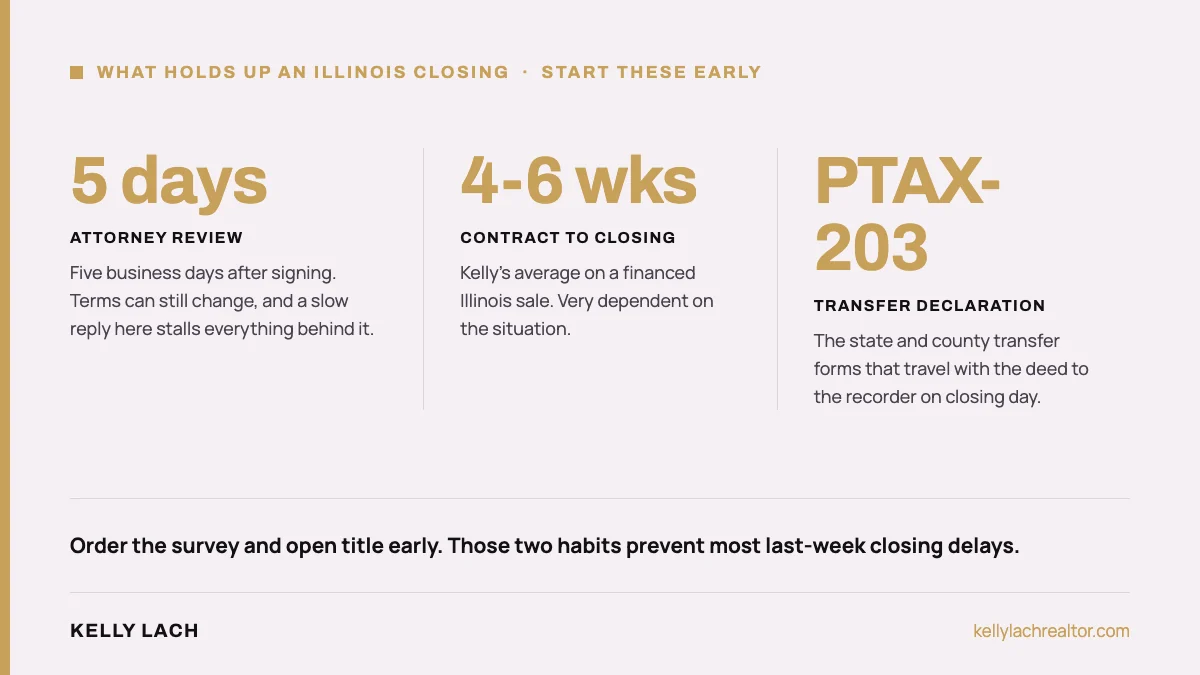
The survey is the one sellers forget. Illinois closings generally expect a current plat of survey from the seller, so if your last one came with your own purchase and a fence has moved since, you want to know in week one rather than week six.
At closing you sign the deed transferring title, along with the Illinois Department of Revenue PTAX-203 transfer declaration, which travels with the deed and reports the sale to the state. County and municipal transfer forms go with it.
The deed is then recorded with the county, which for the Tri-Cities is the Kane County Recorder of Deeds. Recording makes the transfer public record. You hand over keys, remotes and warranties, and proceeds are disbursed once recording is confirmed.
Late-stage problems are boring and repetitive: a payoff letter a day late, a buyer who changes jobs mid-underwriting, a walkthrough that finds a removed light fixture, a municipal form nobody ordered.
Two habits prevent most of it. Start the slow things on day one, meaning title, survey and payoff, because none of them go faster because you are in a hurry. And reply the same day, every day. Almost every delayed Illinois closing traces back to a message that sat unanswered.
Two situations change the sequence enough to need their own map. An inherited property runs through probate and estate steps, handled as probate and estate sales. A divorce adds a layer about who signs and when, covered in selling a house after divorce and on the divorce real estate page.
That is selling a house in Illinois end to end: disclose early, get your attorney engaged before you list, start title and survey in week one, and answer everything the day it arrives.
The blunt version: the paperwork order is what closes an Illinois sale on time, and nobody writes it down because nobody searches for it. Sellers search for what it costs, then lose three weeks to a survey they could have ordered on day one. The cost question turns out not to be the expensive one.
Kelly Lach is a Top 3% agent and St. Charles resident who lists homes across St. Charles, Geneva, Batavia and Kane County. Call 630-674-0424.