

Most of what is written about a divorce house buyout is arithmetic: value, minus what is owed, split by the agreed share. The arithmetic is real, and it is the easy part. Buyouts stall on everything around it: who sets the value, what the deed does and does not do, and whether a lender will carry one name on the loan.
This guide covers that real-estate half, starting from the point where one of you wants to stay. If the house is being sold instead, selling a house after divorce covers that order. If you want one agent working neutrally with both sides and both attorneys, that is the job of a divorce realtor serving St. Charles, Geneva and Batavia. This is a realtor's guide, not legal, lending or tax advice: legal questions go to your attorney, loan questions to your lender. If you do not have an attorney yet, Illinois Legal Aid Online explains the divorce process in plain language.
Before anyone signs a number, check that all three exist:
If any one of the three is missing, there is no buyout yet. There is a plan.
With no buyer to set the price, someone else has to. The options are not interchangeable, and a decree or settlement usually names which one counts.
| Method | Who produces it | What it is good for |
|---|---|---|
| Market analysis or broker opinion | A licensed real estate agent | A fast starting point for talks; not what a lender relies on |
| Licensed appraisal | A state-licensed appraiser | The figure courts and lenders most often lean on |
| Two appraisals, reconciled | One appraiser chosen by each side | When you cannot agree on one appraiser |
| Negotiated figure | The two of you, through your attorneys | When you already agree; still worth testing against the market |
Agree on a valuation date as well as a method, because a figure from last spring may not be the figure today. If the two of you cannot agree at all, the court can decide: the Illinois Marriage and Dissolution of Marriage Act has the court make specific findings on values when it divides property.
One trap catches people every time. Even with an agreed figure, the refinance lender usually orders its own appraisal. If that one comes in lower, the new loan is smaller than the plan assumed and the funding comes up short. Get the house ready for that appraisal the way you would for a buyer's.
| Step | What it changes | What it does not change |
|---|---|---|
| Deed from the leaving spouse | Ownership: they no longer own the house | The mortgage. Both names stay on the loan |
| Refinance in the staying spouse's name | Pays off the old loan and replaces it with a loan in one name | The deed, which still has to be signed and recorded |
| Assumption with a release | The servicer releases the leaving spouse from the existing loan | Whether the loan allows it; the servicer has to approve |
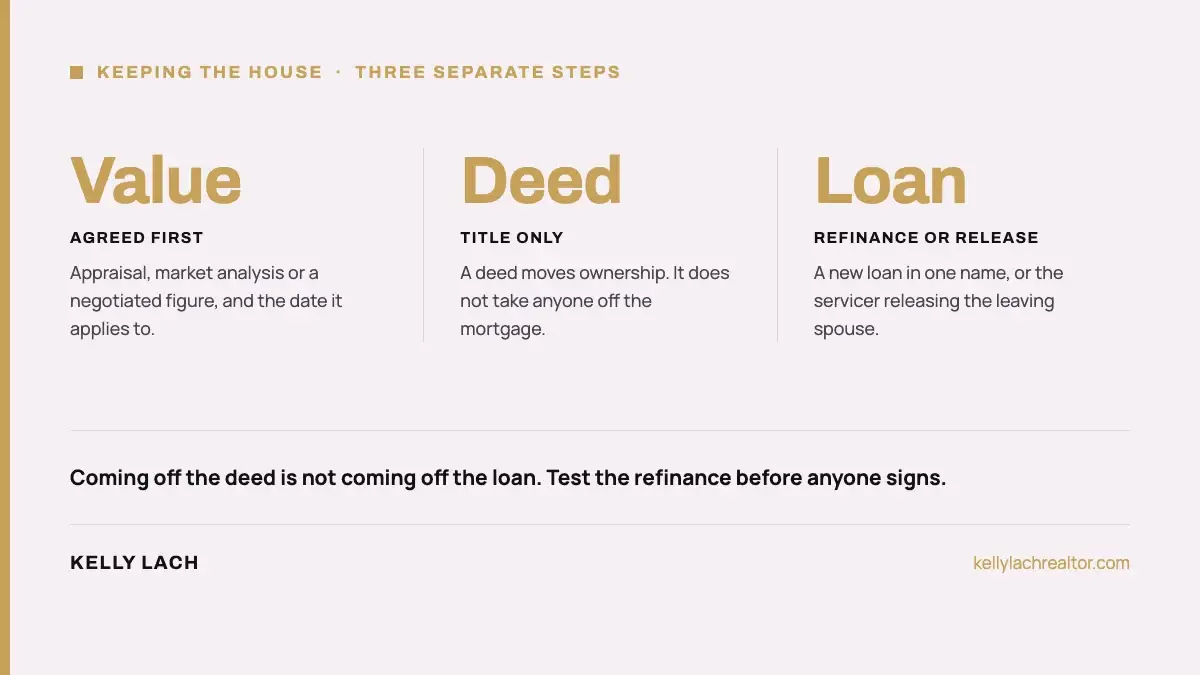
The Consumer Financial Protection Bureau puts it plainly: a divorce decree can assign a debt to one spouse, but a lender can still collect from anyone whose name is on the loan. Signing a deed is not a release. A quitclaim deed is common here, though your attorneys choose the form.
Ask the servicer, in writing, whether the loan can be assumed. The CFPB has reported homeowners after a divorce being steered toward a refinance when an assumption should have been considered, so get the answer on paper.
A refinance tests two things at once, and either one can fail.
The borrower. Income on one paycheck, credit, and existing debts. Lenders have their own rules on whether and when support payments count as income, so ask before assuming they will.
The house. The appraisal has to support the loan, and the appraiser will note condition problems: a leaking roof, safety hazards, unfinished work, water in the basement. Fix those before the appraisal, not after it comes back with conditions attached. You will also be refinancing as the person living there, so the loan will be written on that basis.
The practical move: get a lender's pre-approval for the refinance before the settlement figure is final. If you learn the number cannot be funded, you learn it while it can still be renegotiated.
The equity payment takes a few common forms, alone or together:
On taxes, IRS Publication 504 explains that transfers between spouses incident to a divorce generally trigger no gain or loss, and that the receiving spouse takes over the other spouse’s adjusted basis rather than a new one at today’s value. That basis matters later, when you eventually sell, which Publication 523 covers. Your tax professional should run both.
Many settlements set a deadline for the refinance and say what happens if it is missed, commonly that the house is listed. Read that clause before you rely on the buyout, and talk to your attorney before the deadline passes, not after.
If it does come to a sale, the order matters: who has authority to list, who signs the listing agreement and the deed, and how to set a price without restarting the argument. That is the whole subject of what happens first when you sell after a divorce, and what a sale costs in Illinois is worth reading beside it. How a listing with Kelly runs is on the Tri-Cities home selling page.
Marital property. Section 503 of the Marriage and Dissolution of Marriage Act sets out what is marital and non-marital property and how it is divided. How it applies to your house is your attorney's call.
Disclosure. The Residential Real Property Disclosure Act exempts transfers between spouses resulting from a judgment of dissolution, so the buyout deed itself does not need a disclosure report. A later sale to an outside buyer is an ordinary sale, and the report applies then; selling a house in Illinois walks through it.
Deed and recording. The deed is recorded with the Kane County Recorder. Whether it also needs a PTAX-203 transfer declaration depends on whether the transfer is exempt: the exemptions are listed in the Property Tax Code, section 31-45, none is written specifically for divorce, and a deed that qualifies for one is generally recorded without the declaration. Which one fits, if any, is for your attorney to decide.
That is a divorce house buyout done in the right order: agree on the value and how it is set, test the refinance before the number is final, keep the deed and the loan straight as two steps, and know the fallback before you need it.
The blunt version: buyouts do not fail on the arithmetic. They fail weeks later, when the lender says no. Get the qualifying conversation done before anyone signs a number.
Kelly Lach is a Top 3% agent and St. Charles resident who works as a neutral third party for both sides and their attorneys across St. Charles, Geneva and Batavia. Call 630-674-0424.