
Most of what is written about buying a house after divorce answers one of two questions. Lenders answer whether you can qualify. Attorneys answer when you are allowed. Neither tells you what to do on Tuesday, when you are ready to look at houses again. This guide is the order of operations: what the judgment already decided, how the old house gates the new one, and what an Illinois purchase asks of a buyer signing alone for the first time in years.
It is a realtor's guide, not legal, lending or tax advice. If the house from the marriage is still being sold, selling a house after divorce covers that order first, and if one of you is keeping it, the divorce house buyout covers what has to be true for that to work. When both sides of a Tri-Cities sale need one agent who stays neutral, that is the job of a divorce realtor serving St. Charles, Geneva and Batavia.
In Illinois the court enters a Judgment for Dissolution of Marriage with the marital settlement agreement folded into it, and two paragraphs in it decide your purchase timeline.
The first is the house paragraph: the house sells and the proceeds divide, one spouse keeps it and buys the other out, or you hold it and sell later. Each puts a different date on when your money, or your release from the old loan, shows up. The second is the maintenance and support paragraph: what you pay or receive, and for how long. A lender reads it as income on one side of the ledger or an obligation on the other, and it wants the actual pages.
The Illinois Marriage and Dissolution of Marriage Act is where the court's power to divide marital property and set maintenance comes from. So the first task is a certified copy of the judgment and the complete settlement agreement, signature pages included. Lenders reject partial copies, usually at underwriting, when a contract date is already running.
Three ways to line them up. One is clean; the other two work if the dates are honest.
| Order | What has to be true | What it does for the new purchase |
|---|---|---|
| Sell first, then buy | The old house has closed, the proceeds are in your account, and the old loan is paid off | One borrower, no old payment, funds already documented |
| Buyout first, then buy | The deed is recorded and the old loan is refinanced or released in the other spouse's name | Your share arrives as funds; your name is off the old loan |
| Buy contingent on the old house | The new contract carries a sale contingency, and the seller accepts it | Fastest to a contract, slowest to a closing; many sellers decline the contingency |
Two clocks run underneath that table. In Kelly’s experience an Illinois sale runs 4 to 6 weeks on average from accepted contract to closing, very dependent on the situation, so a sale-first plan needs that much room before your own closing date. A buyout runs on the refinance instead, and a refinance can fail after everyone has agreed on the number. If that is your route, read what has to be true before a buyout closes and do not sign a purchase contract until the new loan has funded.
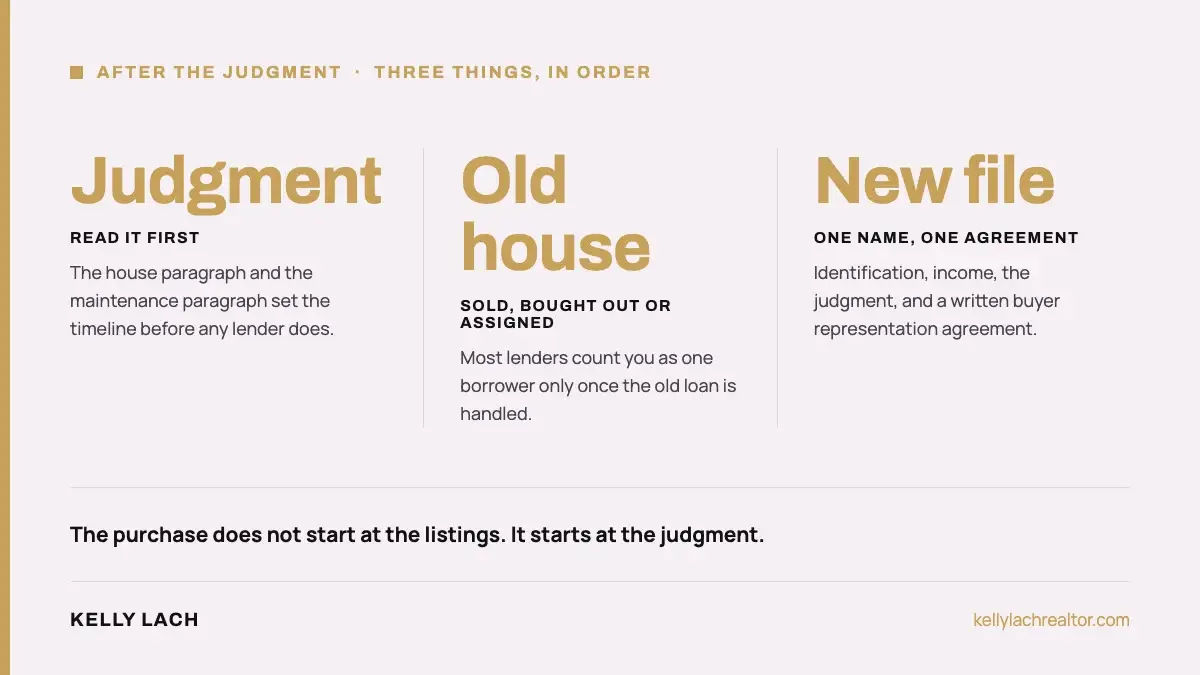
Qualifying is the lender's call. What a realtor can tell you is which documents come up every time, so you have them before pre-approval.
Get a pre-approval, not a pre-qualification, and hand over the judgment when you apply. The Consumer Financial Protection Bureau's home buying guide explains the difference. Every rate, ratio and program question goes to the lender.
If you had an agent during the marriage, that agreement was with both of you. You sign a new one in your own name before anyone shows you a house; a written buyer agreement before touring is now standard practice. Illinois REALTORS publishes consumer guidance on what one should contain, and brokerage conduct in Illinois sits under the Real Estate License Act of 2000.
Read four things in it: who represents you and for how long, what area and property types it covers, how the agent is paid, and how it ends. If this is the first home in your own name, a buyer's agent for a first home in the Tri-Cities covers that side of the table.
Nothing here is unique to divorce. What changes is who signs, where the money comes from, and how much slack the dates need.
| Step | What it is | What it asks of a post-divorce buyer |
|---|---|---|
| Offer and acceptance | A written contract, usually on the standard Chicago-area form | Sign in your own name only, earnest money from your own account |
| Earnest money | Deposited with the listing brokerage or title company within days | Funds must be traceable; sale or buyout proceeds need the closing paperwork behind them |
| Attorney review | Usually five business days for the attorneys to propose modifications | A real estate attorney, not your divorce attorney unless they do both |
| Inspection and radon | Same window; the seller gives the radon disclosure before you are bound, and testing is your choice | Decide before the offer whether you want a radon test |
| Appraisal | Ordered by the lender | If it comes in under the contract price, the gap is renegotiated or it is yours |
| Plat of survey | From the seller; shows the lot lines and anything sitting across them | Read it: a fence or shed on the wrong side of a line is yours after closing |
| Closing | Title company, attorneys, lender; the deed is recorded and the transfer declaration filed | Identification in the name you use now, funds wired from your own account |
The disclosure report comes from the Residential Real Property Disclosure Act, the radon paperwork from the Illinois Radon Awareness Act, and the deed goes to the Kane County Recorder with the state's PTAX-203 transfer declaration unless the transfer is exempt. If the judgment changed your name, tell the title company at contract, not at the closing table.
Three mistakes come up again and again, and each one is a date on a form.
The house you are leaving chose the town for you. The next one does not have to.
St. Charles has the largest downtown of the three, on both banks of the Fox River, older housing close to it, newer subdivisions west of Randall Road, and no Metra station of its own, so rail commuters drive to Geneva. Geneva has the Union Pacific West station downtown, a walkable core along Third Street, and a mix of historic blocks and post-1990 subdivisions. Batavia has the smallest downtown, a riverwalk, older homes near it, newer neighborhoods toward the west, and no station of its own either. The St. Charles neighborhood guide goes block by block, and the same series covers Geneva and Batavia. The live MLS search lets you save a search by town and get updates through the day.
The blunt version: the lender tells you whether you qualify and the lawyer tells you when you are allowed. Neither tells you what to do on Tuesday. Paperwork first, touring second, and nobody loses a house to a date on a form.
Kelly Lach is a Top 3% agent and St. Charles resident who works with buyers and sellers on both sides of a divorce across St. Charles, Geneva and Batavia. Call 630-674-0424.