

When a parent’s house passes to three children, the sale rarely fails over the paperwork. It stalls because one sibling wants to list this month, one wants to wait until spring and one wants to keep the house. Searches for multiple heirs selling a house disagreement bring up cash-offer pitches and legal explainers about whether every heir has to agree. This guide takes the practical question: how do three people run one listing without it turning into a family fight?
This is a realtor’s walk-through, not legal advice. Your attorney answers the legal questions, and this guide covers the listing side for a house in St. Charles, Geneva or Batavia. If you want a local agent to line the two up, probate estate sales in St. Charles, Geneva and Batavia is how Kelly Lach works with executors and heirs.
Before anyone argues about price, find out who is allowed to sign. The answer depends on how the house is held, and your attorney decides it. These are the questions to bring to that conversation:
For the full order of an estate sale, our guide to selling an inherited house in Illinois starts at the first call. This post covers what happens when the heirs do not see the sale the same way.
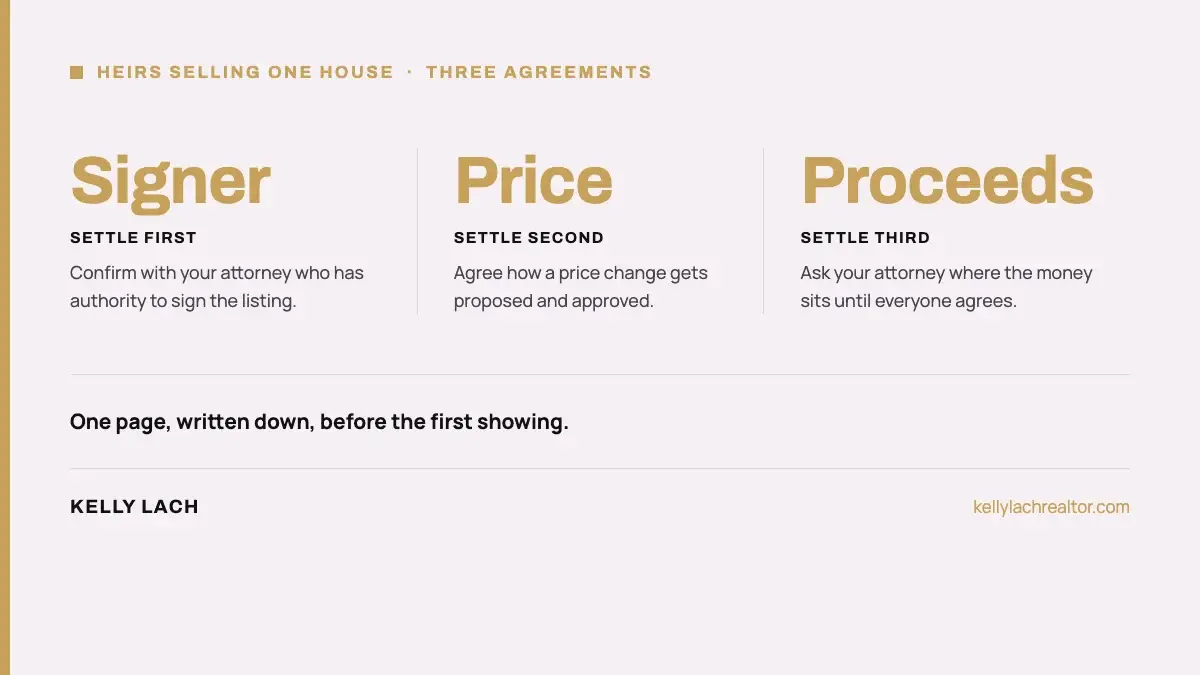
Families fight about a listing mid-stream because nobody decided the rules at the start. Settle these in one page, written down, before the sign goes in the yard. Bring the draft to your attorney so it fits the estate.
| Decision | What to write down | Who helps |
|---|---|---|
| Who may sign | Who your attorney confirms may sign the listing agreement, and whether the other heirs vote or only get informed | Probate attorney |
| Price changes | How a reduction gets approved: who proposes it, who must agree and how fast | Listing agent |
| Repairs | A limit the family sets in advance, and who may approve a repair inside it | Agent, attorney |
| Showings and keys | One person with access, one lockbox plan and who clears out belongings first | Listing agent |
| One contact | A single named person who talks to the agent, so three siblings do not send three sets of instructions | The family |
| Offers | How an offer gets answered, and what happens if the heirs split on it | Attorney, agent |
Treat it as a one-page outline a family can bring to its attorney. Nothing in it is a legal requirement. It is the set of decisions that, left open, turn into arguments at the worst moment, usually the day an offer arrives.
Price is where a loyalty to the house and a need for cash collide. One heir remembers what the house was worth to the family and another remembers what a neighbor’s house sold for. Neither number settles it.
A written market review gives everyone the same page to look at. Ask the listing agent to put recent comparable sales in writing, explain which ones fit the house in its current condition and walk all the heirs through it together, on one call, so nobody hears a second-hand version. A house that has sat unused needs extra care, and our guide to vacant house insurance during probate covers the other early decision.
Agree on the process rather than the number. For example: the family sets a first listing price from the written review, agrees to review it on a fixed date, and writes down in advance what evidence would justify a change, such as showing activity or feedback from buyers. When the date arrives, the decision is already half made.
This is the most common reason a sale stops. One person wants to stay and the others want to be paid. The family has two honest options: the heir who wants the house arranges to take it, or the house goes on the market and everyone moves on.
If someone wants to buy out the others, that is a conversation for your attorney and a lender, not for a listing agent. The question has the same shape as a spouse keeping a house in a divorce, and our guide to the divorce house buyout shows how that decision gets organized. Set a deadline for the buyout answer, and agree with your attorney in advance that the house gets listed if the deadline passes. An open-ended “give me time” is how a listing waits for months.
The blunt version: whether one heir can force a sale is a legal question for your attorney. How to run a listing while three people disagree is a planning question, and the agreement above is the part a family can do this week, before anyone talks to a court.
Proceeds should never be split at the closing table on a handshake. When an estate is open, sale proceeds generally go to the estate, and the representative distributes them under the will, the law and any court supervision, as your attorney explains. At closing the title company handles the funds and shows each payment on the closing statement, so ask to see the statement line by line before closing day.
If the heirs disagree about who is owed what, that disagreement belongs with the attorney, and it should not hold the listing hostage. Some families separate the two questions: sell the house now so it stops carrying taxes and upkeep, and settle the division with the attorney afterward. Whether that works for your estate is your attorney’s call. The title company’s own checklist matters too, and our post on what the title company wants from an executor covers it.
Call the attorney when any of these happens: two heirs will not sign, an offer sits unanswered because nobody can agree, someone threatens to stop access to the house or the family cannot even agree on who the contact should be.
In St. Charles, Geneva and Batavia the process is the same as anywhere in Illinois, and a listing agent’s job is to keep the paperwork and the plan moving. Kelly can set up the listing around the family’s written rules: one named contact, one set of showing instructions and one shared review of the price. She does not decide for the family and she does not give legal advice. Kelly works with executors and heirs through her probate estate sales service. If you want to talk it through, start with a short conversation about the house and bring whatever paperwork you have. The broader sell your home page shows how a regular listing runs for comparison.
Kelly Lach is a Top 3% agent and St. Charles resident who helps executors and heirs in St. Charles, Geneva and Batavia get an inherited house listed in the right order. Call 630-674-0424.