
Selling the house you raised a family in and moving to a 55+ community looks like one event. It is two. One is the sale of your house, which closes on a date written in a contract. The other is your move into the new home, which happens on a date the community or the builder controls. Searches for coordinating closing date with 55+ community bring up moving checklists, community directories and a few agent posts on coordinating two closings. This guide ties the two dates to the questions to ask the community office first.
This guide is about timing and logistics for a sale in St. Charles, Geneva or Batavia. It is a realtor’s walk-through, not legal advice, and it does not describe any community’s rules, because each community states its own. If you want a local agent to help you work backward from the move-in date, senior downsizing help in St. Charles, Geneva and Batavia is how Kelly Lach works with families planning this kind of move.
The first date is your sale closing, when the buyer’s funds move and the deed changes hands. Your contract, your attorney and the buyer’s lender shape it. The second is move-in, when you can start living in the new home. The community, the builder or the seller of that home shapes it.
If closing comes first and move-in is later, you need somewhere to live and somewhere for your belongings. If move-in comes first and closing is later, you may carry two homes for a while. Neither is a mistake, but both are easier when you know about them before you sign. The first job is to find out which of the two dates is fixed and which can move.
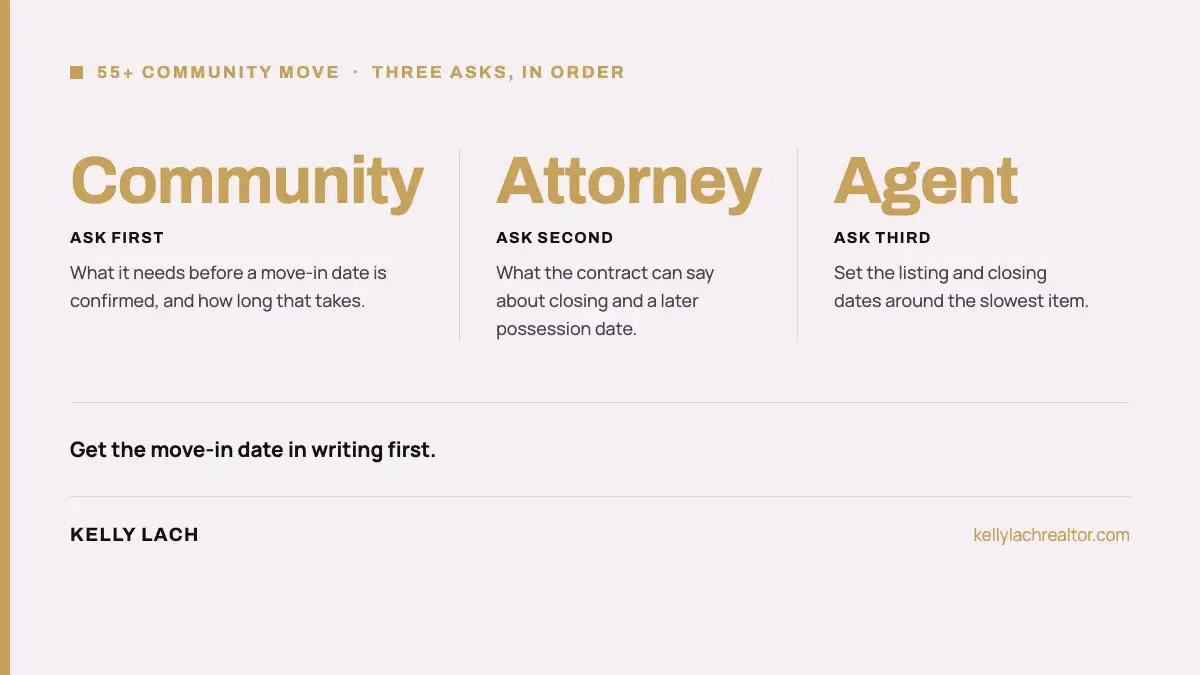
Start with a phone call or visit to the community office, because everything else depends on its answers. Communities differ, so treat this as a list of questions rather than a list of rules:
Write down the answers and the name of the person who gave them. A move-in date that comes from a conversation is a plan. A move-in date confirmed in writing is something you can build a contract around. The U.S. Department of Housing and Urban Development publishes an overview of the Fair Housing Act. This guide stays with timing and leaves the community’s own rules to the community.
The right question depends on which date is firm. Use this table with your attorney and agent. The right answer comes from your contract and your situation, so treat it as a place to start.
| If this is true | Ask this | Ask whom |
|---|---|---|
| New home is ready before the sale closes | What are the options for owning two homes for a short time, and what does each require? | Lender, attorney |
| Sale closes before the new home is ready | Can the contract carry a possession date after closing, and what would it need in writing? | Attorney, buyer’s agent |
| Community approval is still pending | When will it be confirmed, and can I wait for that before I accept a fixed closing date? | Community office, agent |
| Either date slips | What does the contract say about extending, and who needs to hear first? | Attorney, agent |
A possession date later than closing is something the buyer has to agree to, so raise it when you negotiate the offer, not the week before closing. Your attorney decides how that arrangement is written down. For how an Illinois sale moves from contract to closing in general, see selling a house in Illinois: the process.
Each call answers a question the next one depends on.
Doing it in that order keeps you from promising a buyer a closing date that your move cannot meet. If you are also working out how a property tax exemption follows you, our post on why your senior exemption does not move with you covers a second item to settle before the sale.
Even a well-planned sale can leave a few days or weeks between closing on the old house and moving into the new one. Decide in advance how you will cover that stretch, so it does not become a scramble in the last week.
None of this is hard on its own. It becomes stressful when it is all decided at once, so give each item a date on the timeline below.
Adjust the order with your attorney and agent. The timing words describe a planning sequence, and no rule sets them.
| When | What to do | Who helps |
|---|---|---|
| Before listing | Ask the community what it needs and how long it takes, then write down the earliest and latest move-in dates | Community office, agent |
| Before you accept an offer | Decide whether you need a possession date after closing, and raise it in the negotiation | Agent, attorney |
| After the contract is signed | Get the move-in date confirmed in writing, and book the mover only after that | Community office, mover |
| A few weeks before closing | Walk through the closing statement, confirm utilities and mail forwarding and recheck both dates | Attorney, title company |
| If a date slips | Tell the other side the same day and ask what the contract says about extensions | Attorney, agent |
The community sets its own process. We cannot decide it for you, and we cannot promise a move-in date. What we can do is help you ask early, in the right order, and put the answers in writing before a closing date goes in a contract.
In St. Charles, Geneva and Batavia the closing process is the same as anywhere in Illinois, and the extra work for a downsizing sale is the sequencing. Kelly helps families work backward from the move-in date: what to ask the community, what to raise with the attorney and how to set the listing date so the sale does not outrun the move. She works with families planning this kind of move through her senior downsizing service. If you want to talk it through, start with a short conversation about the move and bring any dates you already have. The broader sell your home page shows how a regular listing runs for comparison.
Kelly Lach is a Top 3% agent and St. Charles resident who helps families in St. Charles, Geneva and Batavia plan a sale around the move. Call 630-674-0424.