

A buyer who walks after the inspection leaves a seller with a short list of decisions. The hard part is not the disappointment, it is the Monday after. You may have typed buyer backed out after inspection relist into a search bar on the drive home, and the national articles mostly tell you how often this happens. This guide covers the Illinois seller’s next steps in order, with the disclosure question first because it is the one that can cost you later.
It is a realtor’s walk-through, not legal advice, so your attorney has the final word on the contract and on disclosure. If you are still on the first half of the story, our guide to the inspection modification letter for an Illinois seller covers how to respond while a deal is alive. If you want a listing partner for the second try, selling your home in the Tri-Cities explains how Kelly works.
Do the paperwork before you decide anything about the house.
This is also the right moment to ask your listing agent what the buyer’s side said. The reason the deal ended tells you whether you have a house problem, a price problem or a buyer who simply changed course.
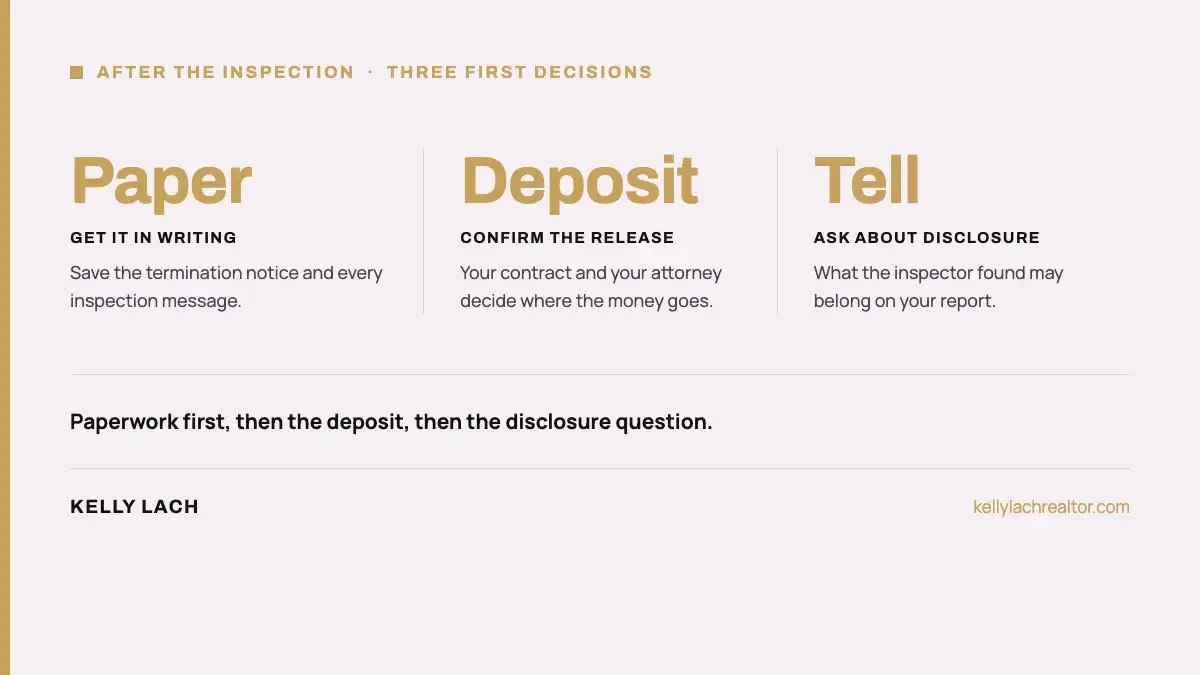
Your contract names who holds the earnest money, often a title company, an attorney or a broker, and it says when the deposit returns to the buyer. If the buyer ended the deal within a contingency and followed the notice rules, the contract may direct the holder to return the money. If there is any disagreement, the holder generally needs a signed release from both sides or a court order before paying out.
Ask your attorney to handle that release. Do not promise the money back in a text, and do not tell the holder to keep it. Treat the deposit as a legal step, not a bargaining chip for the relist.
This is the part sellers underestimate. The Illinois Residential Real Property Disclosure Act sets the rules, and you can read them in full on the state’s own site. A few points matter after a failed deal:
Read together, the practical question is this: what did the first buyer’s inspector tell you that you did not know before, and does it belong on a new or updated report? The statute does not hand you a formula. Your attorney decides how the inspection findings, the dates and your existing report fit together before the house goes back online. Do not guess, and do not rely on an agent to decide it for you.
With the paperwork settled, choose a direction. This table puts the three honest options side by side, with no cost figures because your house and your contractor set those.
| Option | What it solves | What to confirm first |
|---|---|---|
| Fix it before relisting | Removes the item from the next inspection and from the conversation | Who does the work, whether it needs a permit and where the receipts go for the next buyer |
| Relist as-is with the report | Lets the next buyer price the item and avoids repair delay | Your attorney’s view on disclosure, and whether your price still fits what the report shows |
| Offer a credit or price adjustment later | Keeps a motivated buyer when the item is real but small | That the credit is written into the contract and approved by your attorney and the buyer’s lender |
For a deeper look at how each option plays at the negotiating table, the post on answering the inspection letter line by line lays out the three-pile method. For the full order of a sale, see selling a house in Illinois, step by step.
A relisted house will be compared with its own history, so plan for the questions before they arrive.
It also helps to write a one-page summary of the house for the second round: what has been updated, what the inspector looked at, what was repaired and where the paperwork is. Have your attorney read it before it goes to a buyer’s agent, so it matches your disclosure report. A buyer’s agent who sees that page on the first showing has fewer reasons to assume the worst. Nothing on it needs to be dramatic. It simply shows that the seller knows the house and has nothing to hide, which is the impression the first deal may have lost.
Timing matters too. A house that returns to the market within days, with a clear plan, reads very differently from one that sits while the seller decides. You do not have to rush the legal steps above, but you can keep the practical ones moving at the same time.
The blunt version: the articles on this topic tell you how many contracts fall apart and then give general advice about fixing problems. They skip the Monday after, which is the paperwork, the disclosure question and the plan for the next buyer. Do those three in order, relist with a plan, and the second listing starts from a stronger place than the first one did.
Use this as a starting point and adjust it with your attorney.
| When | What to do | Who helps |
|---|---|---|
| Day one | Get the termination in writing and save every message | Listing agent, attorney |
| Days two to three | Confirm the deposit release and the disclosure question | Attorney, escrow holder |
| Week one | Sort the inspection items into fix, credit and as-is | Listing agent, contractor |
| Week one | Decide the price and the repair plan, with receipts saved | You, listing agent |
| Week two | Refresh photos, update the listing and plan the answer to the first question | Listing agent |
If you would like a second set of eyes on the house before it goes back on the market, a short conversation about your timeline is the place to start. To see how nearby homes are presented right now, the Kane County homes for sale page shows the current market.
Kelly Lach is a Top 3% agent and St. Charles resident who helps sellers across St. Charles, Geneva and Batavia plan the next step when a first deal falls through. Call 630-674-0424.