
Buying your first house is mostly a paperwork problem wearing a romance costume. The touring part is easy. The part that decides whether you get the house is the order you do things in, and almost nobody explains that in a way that matches where you are actually buying. This guide is written for St. Charles, Illinois specifically, because the generic advice breaks down here in one very particular way.
If you want someone in your corner for the whole thing, that is what a first-time home buyer agent in St. Charles does. What follows is the map either way.
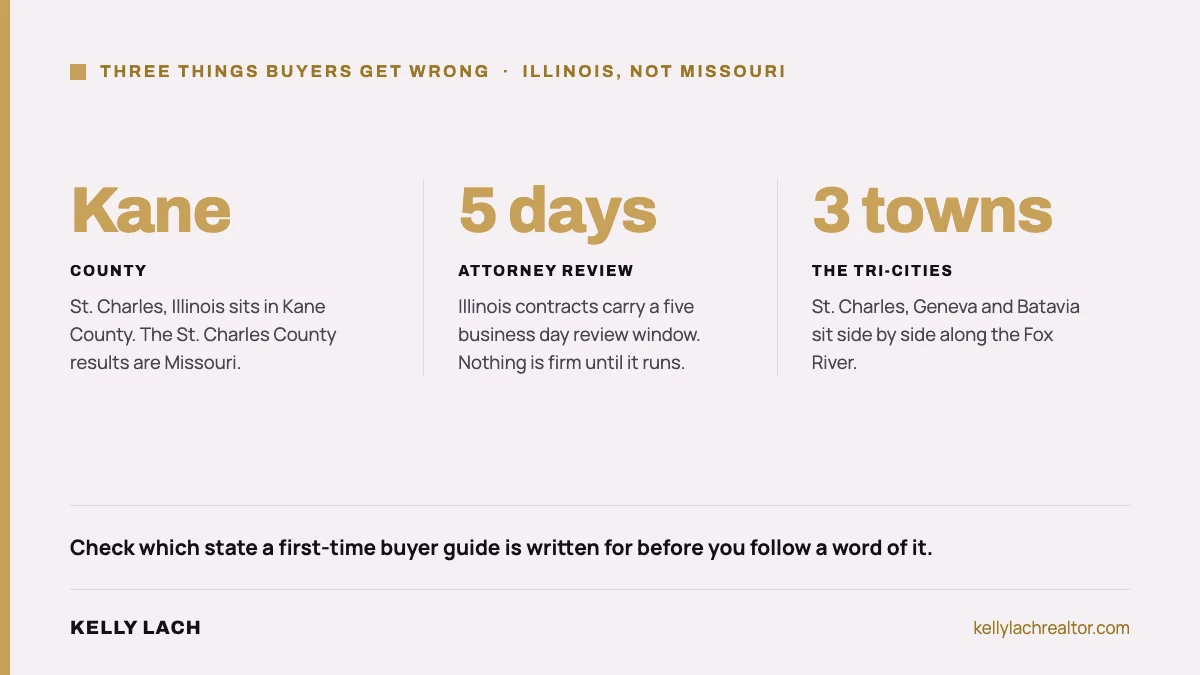
Search for first-time buyer help in St. Charles and roughly a quarter of what comes back is about a different state. There is a St. Charles County in Missouri, near St. Peters, and it has its own association of realtors, its own programs and its own rules. None of them govern a purchase here.
Here is what describes you instead. St. Charles, Illinois sits in Kane County, about forty miles west of Chicago, on the Fox River. It is one of the three Tri-Cities, alongside Geneva and Batavia. Your deed gets recorded at the Kane County Recorder. Your contract follows Illinois law. Your assistance programs come from the City of St. Charles, from Kane County, or from the State of Illinois.
This sounds like a small thing. It is not. A buyer working from a Missouri guide will look for the wrong disclosure forms, expect the wrong closing customs, and apply to a program they cannot qualify for. Before you follow a word of any first-time buyer article, check which state it was written for.
The City of St. Charles runs a first-time homebuyer loan program through its Community Development department, and the part most summaries get backwards is how it fits with the county. The Kane County First-Time Homebuyer Loan Program, administered by the county Office of Community Reinvestment, is the primary program. The city's program, funded through the St. Charles Housing Trust Fund, is supplemental: it works in conjunction with the county's and can add assistance on top when the home you are buying sits inside St. Charles city limits.
So the order matters. Start with Kane County, then ask about the St. Charles addition. Both are structured as deferred-payment loans rather than grants, which means nothing is due month to month, but repayment is triggered by events like selling, transferring title, or the home no longer being your principal residence.
I am deliberately not restating the amounts or the income limits here, because the city and the county are the authorities on them and they change. Read the current terms on the City of St. Charles First-Time Homebuyer Loan Program page, and ask Kane County for the county program terms. Two practical notes: these programs usually expect a homebuyer education course, and they take time to process, so raise it with your lender at the first conversation rather than after you are under contract.
Kane County's own first-time homebuyer program is the one covered above, because for a St. Charles buyer it is where the application starts. Above it sits the Illinois Housing Development Authority, which runs the statewide down payment assistance programs. Do not try to work out which one you qualify for from a blog post, including this one. Eligibility turns on income, household size, credit and the specific property, and a lender who writes these loans regularly will tell you in one conversation what three hours of reading will not. The CFPB's home buying guide is the neutral place to learn what the loan terms mean before you talk to anyone.
This is the part that surprises people who have only bought in other states. An Illinois residential sale runs through a sequence, and each step asks something specific of you.
| Step | What it asks of you | When |
|---|---|---|
| Attorney review | Have a real estate attorney lined up before you write an offer. You get five business days to modify or cancel. Both sides usually have counsel. | Immediately after the contract is signed |
| Earnest money | Deliver your good-faith deposit on the deadline in the contract. Late delivery is a breach, even a friendly one. | Within days of acceptance |
| Inspection | Book quickly, attend if you can, and decide what you will ask for versus what you will live with. | Usually inside the first two weeks |
| Disclosures | Read the seller's Residential Real Property Disclosure Report and the radon disclosure properly. Ask about anything marked yes. | At or before contract |
| Appraisal | Your lender orders it. If it comes in low, you renegotiate, pay the gap, or walk per your contract. | After attorney review settles |
| Survey and title | The seller normally provides a plat of survey. Read it for encroachments and easements. | Two to three weeks out |
| Closing | Bring ID and certified funds, sign, and the deed goes to the Kane County Recorder. | Closing day |
Two of these deserve a second look. Attorney review is the step out-of-state buyers do not expect at all, and it is the one that most often stalls a deal, not because anyone is fighting but because someone is slow to reply. Line up your attorney before you make an offer, not after.
The radon disclosure is the other one. Illinois requires sellers to give residential buyers radon information before the contract is signed, and testing during inspection is routine across Kane County rather than unusual. The Illinois Department of Public Health explains what the readings mean. The radon duty itself sits in the Illinois Radon Awareness Act, which requires the seller to hand the information over before the contract is signed. The broader condition disclosures sit in the Residential Real Property Disclosure Act.
Here is the honest version. Most first-time buyer advice online is written by whoever wants to lend you the money. It is not wrong, exactly, it is just answering a different question than the one you are asking. Their question is "can we qualify this person". Yours is "how do I get a house in this town without making an expensive mistake". Those two questions have different answers and only one of them is on a lender's website.
Losing a house rarely comes down to money. It comes down to terms and timing. The patterns repeat:
None of that requires a bigger budget. It requires being ready before you need to be.
If you do these in order, you will be ahead of most of the people you are competing with.
Two things this guide deliberately leaves alone. If you are weighing up which part of town suits you, that is a separate question and it lives in the St. Charles neighborhood guide. And if you are considering a brand-new build rather than a resale, the process is genuinely different, which is covered in new construction in St. Charles.
Kelly Lach is a Top 3% agent and St. Charles resident who works with first-time buyers across St. Charles, Geneva, Batavia and Kane County. Call 630-674-0424.