

Most advice on how to sell a luxury home is written to recruit the seller. It says the market is different, the buyers are different, and you need a specialist, and then it stops. True enough, and it gives you nothing to do.
This guide is the working order instead: what to decide first, how a price gets set when nothing nearby compares, how exposure and showings work when the buyer pool is small, and what an Illinois closing adds at this level. If you would rather hand that order to someone who runs it, that is what a luxury real estate agent in St. Charles, Geneva and Batavia is for. This is a realtor's guide, not legal or tax advice.
Luxury is not one market. The buyer for Fox River frontage is rarely the buyer for ten acres west of Randall Road, and neither is the buyer comparing your new-build against building their own. Name the type first, because it sets where you market, what you photograph and what the buyer will pick apart.
| Type of sale | What the buyer is paying for | What they check first |
|---|---|---|
| Estate home in town | Space and finish close to a downtown | Roof, mechanicals, and how the updates were done |
| Riverfront | The river itself | Flood zone, the survey, shoreline and access |
| Acreage | Land and distance from neighbors | Well, septic, zoning, outbuildings, boundaries |
| New-build showpiece | New without the wait to build | Builder warranty transfer and what is still covered |
| Historic | Original character | What is original, what was restored, local district rules |
Comparable sales work when there are enough similar homes that sold recently nearby. At the top of a local market there often are not. The closest "comparable" might be on a different street, a different size of lot, or from a different year, and every adjustment to make it fit is a guess someone can argue with.
So the price gets built from several methods that check each other:
Keep one more reader in mind: the appraiser. A buyer's lender will send one, and that appraiser has the same comparable problem you do. A price you cannot explain on paper tends to come back as a renegotiation a few weeks after you accepted it.
Do the work in this order, because each step changes what the next one costs:
What to leave alone: a large remodel right before listing, or anything that reflects one person's taste. Buyers at this level often plan their own changes, and they will not pay you for yours.
Hire professional photography, twilight exteriors, a measured floor plan and a video walk-through. For acreage or river frontage, add aerial images from an operator certified to fly commercially. The land is often a large part of what you are selling, and it does not show from the driveway.
Before approving the set, check that the images represent the lot and its boundaries honestly, that the floor plan matches the house, and that nothing in the frame gives away too much: mail, family photos, the location of a safe, security panels.
The written description should read like a spec sheet with a point of view. Materials, the year of each update, what the land does, what the house is close to.
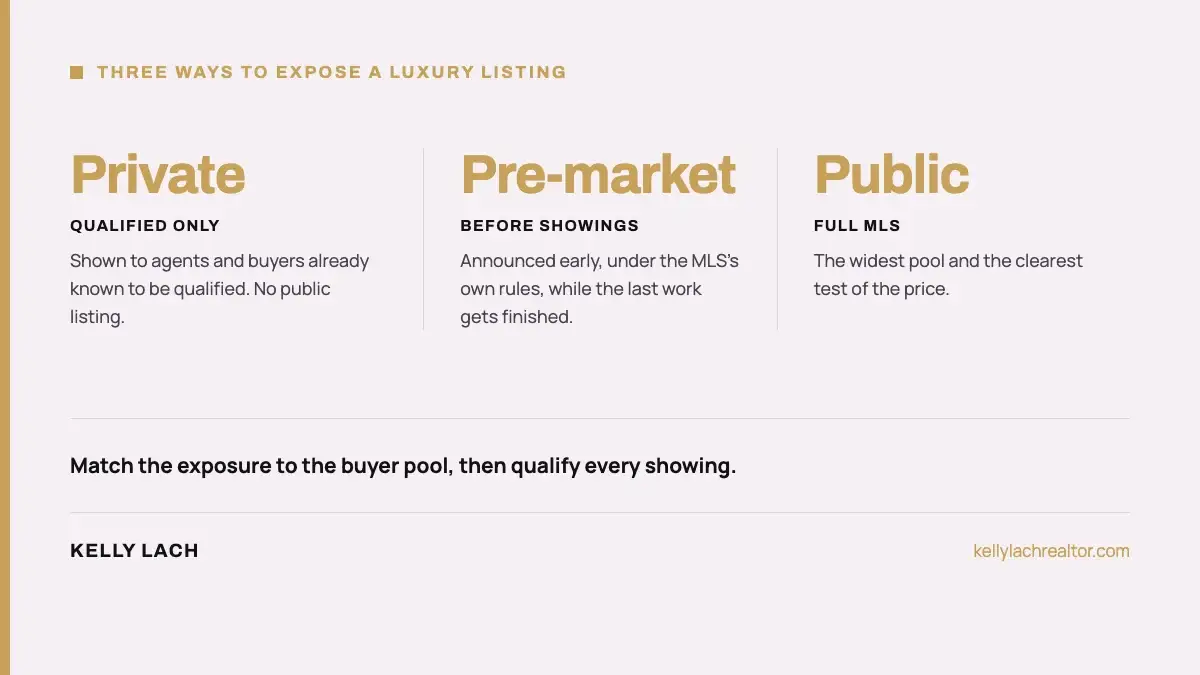
| Channel | How it works | When it fits |
|---|---|---|
| Private | Shown to agents and buyers already known to be qualified; no public listing | Privacy matters more than reach, and you accept a smaller audience |
| Pre-market | Announced before showings start, under the MLS's own rules | You want interest building while the last work gets finished |
| Public MLS listing | Full exposure on the MLS and every site it feeds | You want the widest pool and the clearest price test |
MLS rules on office-exclusive and delayed marketing have changed in the last few years and differ from one MLS to the next. Before you pick a channel, ask exactly how the current rules work in MRED, the MLS that covers Kane County. Whoever runs the listing, you can confirm their Illinois license through the Illinois Department of Financial and Professional Regulation.
Showings get qualified. Ask for proof of funds or a lender's pre-approval before a private showing, keep every showing agent-accompanied, and put away valuables, documents and medications. If the house has cameras, tell your agent, and ask your attorney before anything records audio.
| Contingency | What to ask | Why it matters here |
|---|---|---|
| Financing | What kind of loan, which lender, how far along the approval is | Larger loans get more underwriting scrutiny and take longer |
| Appraisal | Will the buyer cover a gap if the appraisal comes in under the price | Fewer comparables means more appraisal risk |
| Sale of the buyer's home | Is their current home already under contract | A second chain adds a second closing that can fail |
| Inspection scope | Which inspections, and how many days | Acreage and older homes add well, septic, sewer and chimney inspections |
A higher offer carrying all four is often worth less than a cleaner one. Read the terms before the top line.
Disclosure. The Residential Real Property Disclosure Act requires a written disclosure report before the contract. The Act exempts certain transfers, such as court-ordered sales, fiduciary sales from an estate or trust, and newly built homes that have never been occupied. A privately owned home you have lived in is generally not one of them. Radon information is separate, under the Illinois Radon Awareness Act.
Attorney review. The standard residential contract used across the Chicago area gives both sides five business days for their attorneys to review it. Terms can change inside that window, so have your attorney engaged before the first showing.
Survey and flood maps. Most Illinois closings expect a current plat of survey. On acreage and river frontage, boundaries, easements and flood zone questions surface here, so order it in week one and check the property on the FEMA Flood Map Service Center.
Taxes. IRS Publication 523 explains the home-sale exclusion, and it has a cap. A home held for decades can exceed it, so talk to your accountant before you list, not after you close.
Closing. You sign the deed and the PTAX-203 transfer declaration, and the deed is recorded with the Kane County Recorder. The ordinary order of an Illinois sale is laid out in selling a house in Illinois, step by step, and what a sale costs lives in the cost of selling in Illinois.
In Kelly’s experience an Illinois sale runs 4 to 6 weeks on average from accepted contract to closing, very dependent on the situation, and on a high-value home the appraisal and underwriting are what usually decide which end of that you land on.
Where the house sits changes the emphasis, not the order. A river lot in Geneva leans on the survey and the flood map; acreage west of Randall Road leans on the well, septic and boundaries. The St. Charles area guide covers the towns themselves, and the Tri-Cities home selling page covers how a listing with Kelly runs.
That is how to sell a luxury home in practice: decide the type of sale, build a price you can defend to an appraiser, finish the house before the camera arrives, pick the exposure on purpose, and pressure-test every contingency.
The blunt version: most luxury-selling articles are written to recruit you, not to inform you. Luxury is not a different transaction. It is the same Illinois transaction with fewer buyers, more scrutiny and less room for a guess.
Kelly Lach is a Top 3% agent and St. Charles resident who handles luxury listings across St. Charles, Geneva and Batavia. Call 630-674-0424.