

St. Charles has a downtown full of houses older than anyone living in them, and a good number of them sit inside a local historic district or carry a landmark plaque. The city's pages explain the St. Charles IL historic district certificate of appropriateness as a form. This guide explains it as part of a sale: what a buyer should confirm before an offer, what a seller should disclose about work that was approved or is still pending, and where the review can change a timeline.
It is general information from a realtor, not legal advice, and the city decides every application. Kelly is a St. Charles resident, and the older streets near the river are a big share of the town's high-end and character stock, which is why a luxury real estate agent in the Tri-Cities needs to know how this works. For the town itself, see living in St. Charles, IL.
The rule lives in Chapter 17.32 of the St. Charles City Code. The city's summary: approval of a certificate of appropriateness is required to obtain a building permit for any construction, alteration, repair, demolition or relocation that affects the exterior architectural appearance of a building in a historic district or a landmark site. The certificate covers the site as well as the building.
The same city guidance draws the line on the other side. A certificate is not required for work that does not require a permit, and the city names painting and tuckpointing as examples. So the first question for any project is whether it needs a building permit at all. If it does, and the house is in a district or is a landmark, the certificate comes first.
| Your project | Needs a permit? | Needs a certificate? |
|---|---|---|
| Painting the exterior | No | No |
| Tuckpointing | No | No |
| Exterior alteration, addition or demolition | Yes | Yes, before the permit issues |
| Some smaller permitted projects | Yes | Yes, some approved by staff |
| Interior-only work | Depends on the work | Exterior appearance is what is reviewed |
The city publishes the full list of which projects need review, which need a certificate and which need a building permit on its Certificate of Appropriateness page, along with the Administrative Approval List. Treat the city's list as the answer for your house, not this table.
Not every certificate goes to a public meeting. The city says certain types of projects can be reviewed and approved administratively by staff, without going before the Historic Preservation Commission. The rest go to the Commission, which meets on the first and third Wednesday of each month at 7:00 pm in the Council Chambers at the Municipal Center.
The Commission reviews against the federal Secretary of the Interior's Standards for Rehabilitation, the national guidelines for changing an old building without losing what makes it historic. The city also publishes its own design guidelines for historic properties. Read them before you pay for drawings.
Two pieces of the city's advice matter most for timing. Apply for the certificate before you finalize construction drawings or order materials. And building permits that need a certificate cannot be issued over the counter. For larger projects the city recommends getting the certificate before drawings are prepared at all.
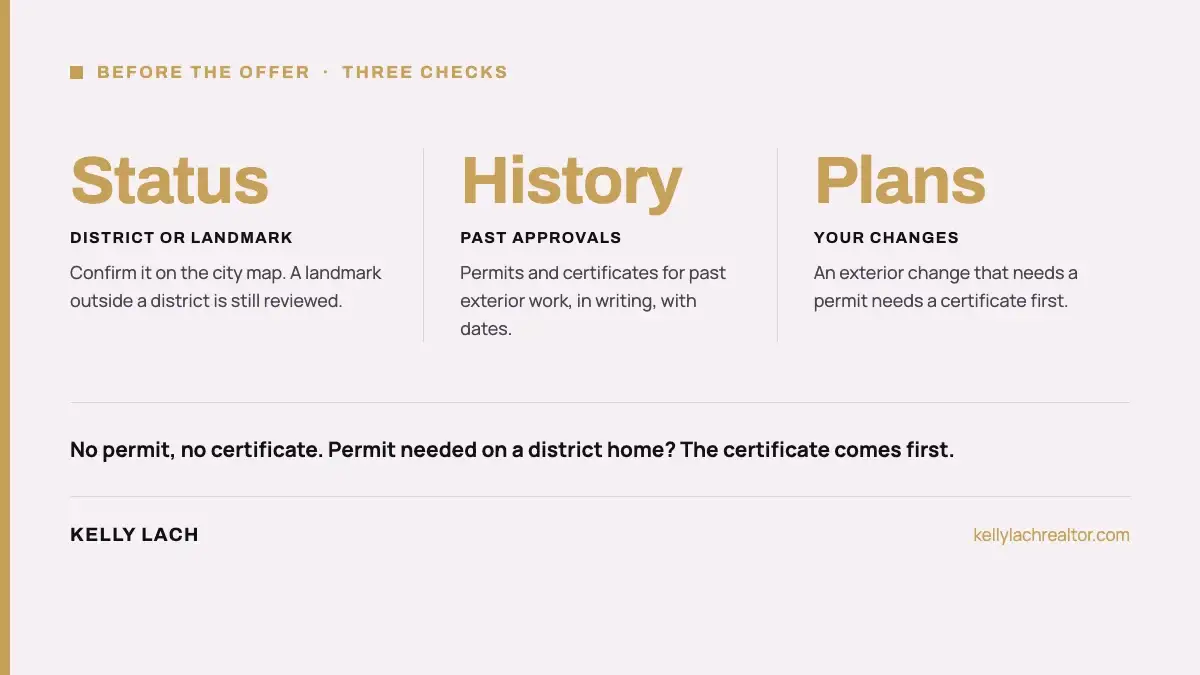
The questions are short. Getting the answers late is what causes trouble.
Status. Is the house in a historic district, a designated landmark, or neither? The city's FAQ points to its Architectural Surveys page and the My Property Info map for the lookup, and landmarks carry a plaque. A landmark outside a district is still subject to review.
History. Ask the seller for building permits and certificates for past exterior work: windows, siding, porches, garages, additions. If the house was rehabilitated, ask whether any state tax program was involved, because that can carry its own conditions.
Your plans. If the reason you want the house depends on an exterior change, such as a rear addition, a new garage or different windows, find out whether it needs a certificate and whether it is likely to go to the Commission. The attorney review and inspection periods in an Illinois contract are the window to ask the city, not after closing.
Interior plans are a separate conversation. The review is about exterior architectural appearance, so a kitchen or bath goes through the regular permit process. Confirm that with the city for your specific project before you count on it.
Buyers of historic homes in St. Charles tend to ask about approvals early, often at the first showing. A seller who answers in writing looks like a seller with nothing to hide.
The Illinois disclosure report under the Residential Real Property Disclosure Act is about known material defects. Historic status and approvals sit outside that form, so put them in their own written summary for buyers. The rest of the Illinois paperwork order is in the guide to selling a house in Illinois.
Plan pre-listing work around the review too. Painting and tuckpointing need no certificate, which makes them the quick improvements before photos. Anything that needs a permit and a certificate should either be finished before you list or left for the buyer, with the city's guidance in hand.
The federal standards the Commission follows lean toward repairing original features before replacing them, and toward new work that is compatible with the old without copying it. That has a practical effect on a project. Original wood windows, porches, trim and masonry are often expected to be repaired where they can be, and where something is replaced, the material and the look of the replacement matter.
That shapes who you hire. A contractor who has worked on older houses in St. Charles and knows the city's process can tell you early which parts of your plan are routine and which will take a meeting. A designer who reads the design guidelines first saves you from paying for drawings twice.
It shapes the calendar too. Work that needs the Commission waits for one of its two monthly meetings, and an application that comes back with questions waits for the next one. If you are buying with a project in mind, plan the first months of ownership around that calendar rather than around a contractor's open week. If your timeline is tight, ask the city early whether your project is one staff can approve.
The city's FAQ lists three. Residential properties in a historic district may qualify for the state's Property Tax Assessment Freeze program, which the Illinois State Historic Preservation Office runs for owner-occupied homes that complete a substantial rehabilitation to the federal standards. Owners of income-producing property in a historic district may qualify for federal income tax credits. And properties in the city's historic districts can apply for the city's Facade Improvement Grants, which the Commission reviews and recommends. Each program sets its own rules, so read the program page and apply before work starts.
The city also offers a Certificate of Economic Hardship. If approved, it lets a project go ahead without a certificate of appropriateness. That is a request you make in writing, with your own attorney involved.
The blunt version: in St. Charles the certificate follows the building permit. No permit, no certificate. If a permit is needed on a district house or a landmark, the certificate comes first and it does not happen over the counter, so put it on the calendar before you sign.
Kelly Lach is a Top 3% agent and St. Charles resident who works with buyers and sellers across St. Charles, Geneva and Batavia. Call 630-674-0424.