

West of town, St. Charles turns into acreage: wooded lots, horse properties and custom homes on long driveways. Many of those houses have no city water or sewer. If you are buying one, a well and septic inspection in St. Charles, IL is not an add-on. It is how you find out whether the two systems the house depends on actually work, before the inspection period in your contract closes.
This guide covers what to order, who does each piece, and how to fit it into an Illinois contract timeline. It is a realtor's guide, not engineering or legal advice. Buyers shopping estate property across the Tri-Cities usually start on the luxury homes page for St. Charles, Geneva and Batavia, and the wider county search lives on homes for sale in Kane County.
Start with the address. Kane County's rural grid addresses, the ones with a direction and a number like 39W or 5N in front of the street name, are a strong hint that the house sits outside city limits even with a St. Charles mailing address. Inside the city, homes are typically on municipal water and sewer. Outside, many are not.
Do not stop at the hint. Some subdivisions outside town have shared water systems, and a few houses inside town limits have older private systems. Ask the listing agent directly, ask for the water and sewer bills or the last pumping receipt, and read the listing's utility fields. Then confirm it at the inspection.
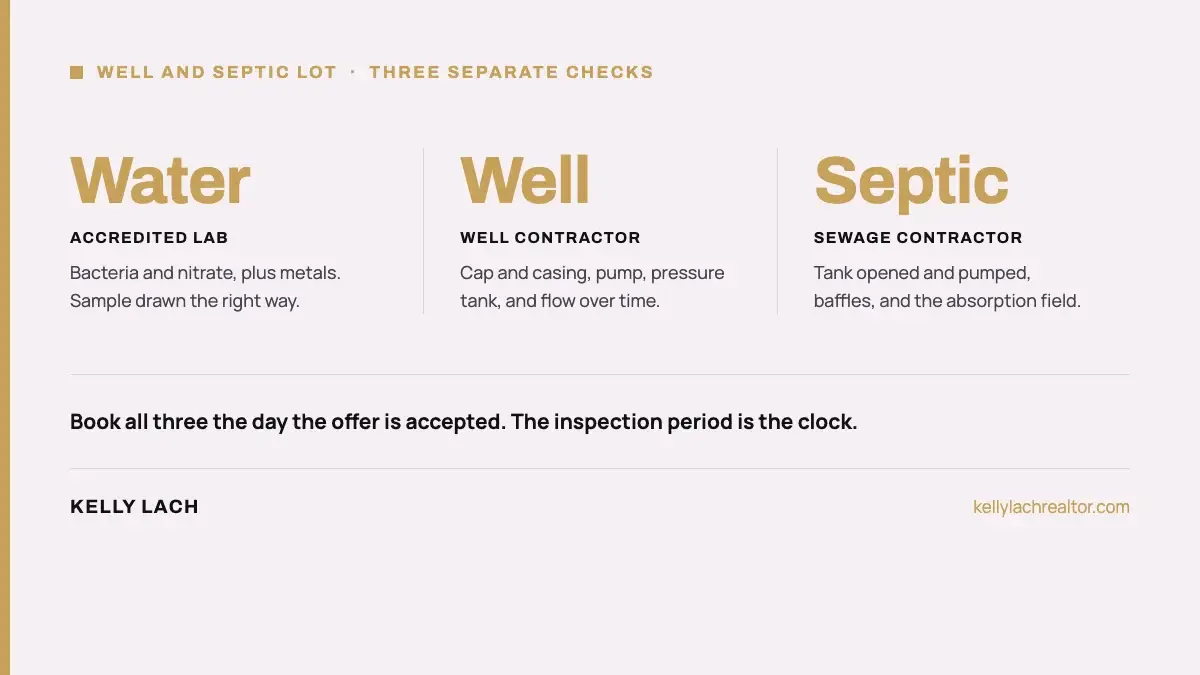
Three separate checks, done by different people. A general home inspector may look at the pressure tank and the visible plumbing, but that is not an inspection of either system.
| Check | Who does it | What it tells you |
|---|---|---|
| Water test | An accredited laboratory, from a sample taken the right way | Whether the water shows bacteria, nitrate or other problems right now |
| Well system check | A licensed water well contractor | The condition of the well cap and casing, pump, pressure tank and flow |
| Septic evaluation | A licensed private sewage contractor | Tank condition and level, the baffles, and whether the absorption field is accepting water |
The Illinois Department of Public Health regulates private sewage systems and licenses the contractors who install and pump them, under the Private Sewage Disposal Licensing Act and the Private Sewage Disposal Code. The IDPH private water program covers well construction and points to the Illinois EPA list of accredited labs. Ask each contractor for their license number and write it down.
For a private well, the Kane County Health Department recommends testing for bacteria (a total coliform test) and nitrate or nitrite every year, and for metals every three years. A purchase is a good time to do the full set, because it is the one moment you can still negotiate.
How the sample is taken matters as much as the lab. A sample from a kitchen faucet with an aerator, or from a tap after a softener or filter, can tell you about the filter instead of the well. The lab or the well contractor will tell you where to draw it. If the house has a treatment system, ask what it treats and when it was last serviced.
Many lenders ask for a passing water test when a house runs on a private well. Ask yours early so the test you order also meets their requirement and you do not pay for it twice.
The well contractor looks at what you cannot see from the basement: whether the cap is sealed, whether the casing is in good shape, how the pump and pressure tank perform, and whether the flow holds up when water runs for a while. A house that looks fine on a ten minute shower can struggle when a lawn irrigation system and a full household run together.
Ask for records. The seller may have drilling or repair paperwork. The Illinois State Geological Survey keeps a public database of water well records, ILWATER, that can show a well's construction details when one was filed. Kane County issues permits for new wells, modified wells and well sealing, so an old unused well on the property is worth asking about as well.
A septic evaluation done for a purchase usually means opening and pumping the tank, so the contractor can see its condition, the baffles and the level, and then checking whether the absorption field is accepting water. A tank that was pumped the week before a showing can hide a slow field, so ask when it was last pumped and by whom.
Bring the seller's records if they exist: pumping receipts, the original permit and any repair permits. Know where the tank and the field sit before you plan a pool, an addition or a new outbuilding, because a system takes up ground you cannot build on.
If the evaluation finds a problem, the fix is a licensed contractor's estimate and a permit, not a guess. That estimate is what your attorney uses to negotiate.
A report with a problem in it is not the end of the deal. It is information, and the inspection period is the time to use it. The usual outcomes are the same as for any inspection item: the seller repairs before closing, the parties agree to an adjustment, the buyer accepts the condition, or the buyer ends the contract within the period the contract allows. Your attorney handles the request and the wording.
Some results have a simple next step. A water test that shows bacteria often leads to the well being disinfected by a contractor and a retest, and a result that comes back clean on the retest is a different conversation from one that does not. A septic tank that only needs pumping is routine. A failing absorption field is a larger project with permits and a licensed installer, and that is where a contractor's written estimate matters most.
Whatever the result, get it in writing from the licensed contractor or the lab, with the date and the address, and keep it. When you sell the house one day, those records answer the next buyer's questions before they are asked.
On a larger estate property the well and septic checks sit alongside other specialists, and luxury home specialty inspections in Illinois covers the rest of that list.
An Illinois purchase contract gives you an attorney review period and an inspection period, usually measured in business days. Well and septic contractors book up, lab results take time, and a septic evaluation needs the seller's permission to dig. The schedule is the risk.
If you are new to the Illinois steps, the Illinois sale process, step by step shows the same contract from the seller's side, and the order is the same.
The blunt version: on an estate lot the well and the septic are the plumbing and the sewer, and a well and septic inspection in St. Charles, IL is how you find out whether they work. A general inspection does not test them. Three checks, three licensed people, booked the day the offer is accepted.
Kelly Lach is a Top 3% agent and St. Charles resident who helps buyers through estate and acreage purchases across St. Charles, Geneva and Batavia. Call 630-674-0424.