
Most of what has been written about the buyer agency agreement Illinois buyers now sign answers one question: do I have to sign one? The answer is yes if you want an agent to show you houses, and the national practice changes of August 2024 made a written agreement before touring standard practice across the country. What almost nobody writes is the next page: what the form in front of you says, which blanks are negotiable, and what happens when the numbers on your agreement and the seller’s offer do not match.
This is a realtor’s guide to reading the document, not legal advice. If you are buying for the first time in St. Charles, Geneva or Batavia, the first time home buyer agent you work with is the person who hands you this form, so it helps to understand it before the pen comes out.
Buying your first home in Geneva instead? What a real estate agent for first time buyers does in Geneva lays out how a first purchase there goes.
The Illinois Real Estate License Act of 2000 settled the agency question long ago. Section 15-10 says a licensee working with you is your designated agent unless a written agreement with the sponsoring broker says otherwise. Exclusive agreements had to be written well before 2025, and since January 2025 the Act’s definitions say all brokerage agreements shall be in writing. Section 15-75 says an exclusive agreement must spell out the minimum services the brokerage owes you: presenting offers and counteroffers, helping you develop and negotiate them until the contract is signed and the contingencies are cleared, and answering your questions about them. The full text is on the Illinois General Assembly site, Article 15.
So an Illinois buyer’s experience changed less than the national news suggested. What did change is the emphasis on the pay clause. Since January 2025 (Public Act 103-1039), Section 15-35 has required the licensee representing you to discuss the brokerage’s compensation policy with you, including the terms of compensation and any amounts offered to cooperating brokers. Have that conversation before you sign; the pay clause is the part to read slowest.
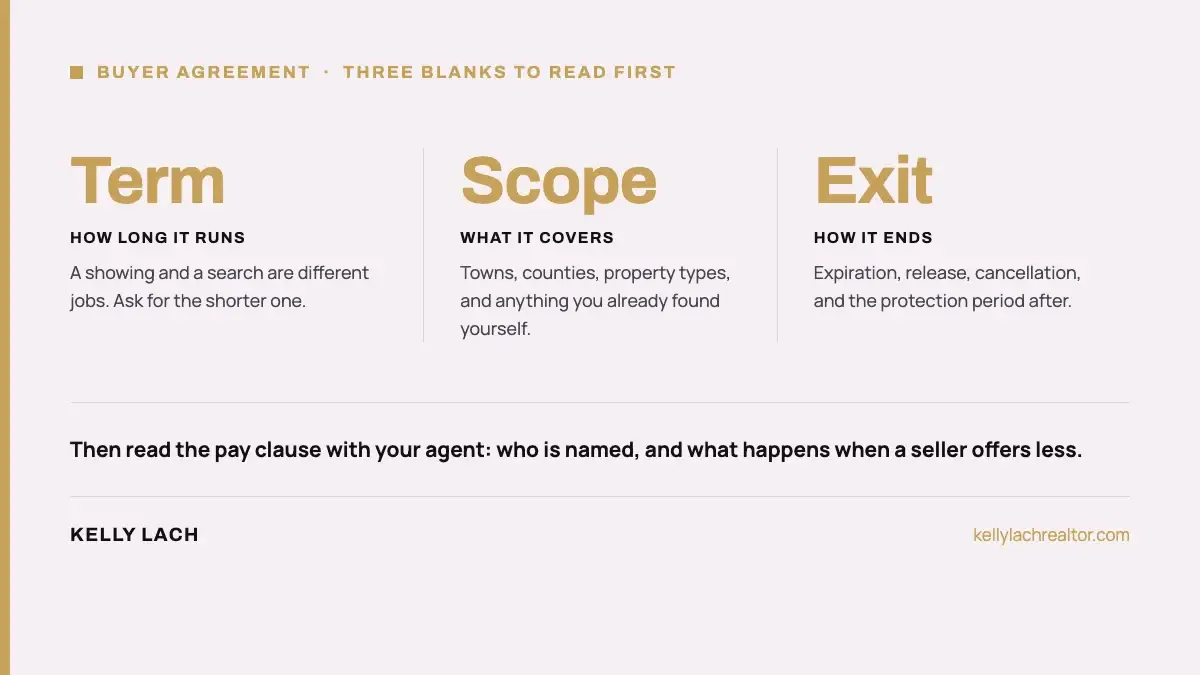
The first blank most buyers skip is the date the agreement ends. It decides how long you are committed if the relationship is not working.
A first showing and a full search are different jobs. If you want to see one house this weekend, ask for an agreement that covers that showing, or a short term measured in days. If you are starting a search that will run through a season, a longer term is fair, because the agent is investing weekends in you. Ask for the shorter one; a reasonable agent will say yes, and an agreement can always be extended in writing.
Check how renewals work too. Some forms end on the date; some roll forward unless someone cancels.
The agreement describes what it covers, usually a geographic area and property types. In the Tri-Cities that blank deserves thought, because the towns sit close together and a buyer looking at homes for sale across Kane County can drift from St. Charles into Geneva, Batavia, Campton Hills or the unincorporated grid addresses west of Randall Road without noticing.
Three things to put in writing:
Scope cuts both ways. A narrow agreement protects you on a house you found elsewhere; a wide one obligates your agent to work the whole area for you, including the Section 15-15 duties to present offers promptly and disclose the material facts they know. Pick the scope that matches your search.
This is the clause the national settlement was about. No numbers here, on purpose; the numbers belong in your agreement and your conversation with your agent.
The clause says three things. What the buyer’s brokerage is to be paid. Who is named as paying it. And what happens when the seller’s side offers a different amount than the agreement states. That third part is where buyers get surprised: the difference can come out of the buyer’s pocket, or be negotiated into the purchase contract as a seller concession.
| Scenario | Who is named | What usually happens |
|---|---|---|
| Seller offers what the agreement states | The seller’s side pays the buyer brokerage | Nothing further from the buyer |
| Seller offers more than the agreement states | The agreement caps what your brokerage can take | Under the national practice rules, your agent cannot collect above the agreed amount |
| Seller offers less, or nothing | Often the buyer, per the agreement | The gap is asked for as a concession in the offer, or paid by the buyer at closing |
| Seller offer is unknown at signing | The agreement still names a figure | Your agent finds out per listing; ask before each offer |
Two practical points. Before each offer, ask your agent what that listing’s seller is offering, so the gap is never a surprise at closing. And treat the gap as a term of the offer like any other. It goes in the contract, it is negotiated like price and closing date, and your attorney sees it in review.
An agreement ends four ways. It expires on its date. Both sides agree in writing to release each other. One side cancels under whatever cancellation language the form carries. Or you close on a house, which completes it.
Read the protection period if there is one. It is the stretch after the agreement ends during which you may still owe the brokerage if you buy a house they showed you. It exists for a reason, and it is also a blank. Ask how long it runs and whether it covers every house you saw or only houses on a list the agent gives you at the end.
Section 15-30 of the License Act is worth knowing here. After a brokerage agreement ends, the brokerage owes you almost nothing further, with two exceptions: accounting for your money and property, and keeping your confidential information confidential. So what you told your agent about your budget or your reasons for moving stays confidential after you part ways.
A buyer agency agreement is not a purchase contract. It does not obligate you to buy anything. It is not a mortgage pre-approval, and signing it does not qualify you for a loan. It does not bind the seller to anything at all.
It also does not make your agent a dual agent. Under Section 15-45, an Illinois licensee can represent both sides of the same sale only with the informed written consent of every client, on a specific disclosure the Act spells out. If you are ever handed that form, read it on its own terms and ask why.
It also does not stop you from walking into an open house on your own; what you can do before signing anything depends on how the listing is being shown.
Once the form is right, the search is the easy part. The live MLS search saves a search by town and sends updates through the day, the St. Charles neighborhood guide goes block by block, and the first-time buyer walkthrough for St. Charles picks up the contract steps from here.
The blunt version: most pages on this subject are written to reassure you into signing. The form is a negotiation and almost nobody treats it like one. The buyer who reads the term length, the scope and the pay clause gets a better agreement than the buyer who signs the default, and it takes ten minutes.
So the buyer agency agreement Illinois law requires is less a hurdle than a conversation you are entitled to have. Have it before the first showing, get the answers in writing, and the rest of the purchase runs on a document you understand.
Kelly Lach is a Top 3% agent and St. Charles resident who walks buyers through the agreement before the first showing, across St. Charles, Geneva and Batavia. Call 630-674-0424.