
“What will I actually walk away with?” is the first question most Tri-Cities sellers ask, and it deserves a real answer — not a vague “about six percent.” The cost to sell a house in Illinois is a stack of line items: agent commission, transfer taxes, an attorney, title charges, a property-tax credit to the buyer, and whatever prep your home needs to show well. This guide breaks each one down with real numbers, then runs a full net-proceeds example on a $500,000 St. Charles sale so you can see where every dollar goes.
Here is every cost a Tri-Cities seller typically faces, with a representative figure on a $500,000 home (roughly the St. Charles median). Your numbers will vary with your price, your loan payoff and your closing date, but the categories are the same on almost every sale.
| Cost | Typical on $500K | What it is |
|---|---|---|
| Real estate commission | $25,000 (about 5%) | Negotiable. Since 2024, the buyer’s agent’s fee is negotiated separately rather than automatically set by the seller. Many sellers still budget 5–6% total. |
| State transfer tax | $500 | $0.50 per $500 of price ($1.00 per $1,000), paid by the seller in Illinois. |
| Kane County transfer tax | $250 | $0.25 per $500 ($0.50 per $1,000), also paid by the seller. |
| Municipal transfer tax | $0 | St. Charles, Geneva and Batavia charge no city transfer tax — a real advantage over many Chicago-area suburbs. |
| Real estate attorney | $500–$1,000 | Illinois closings are handled by attorneys. Most charge a flat fee. |
| Owner’s title policy + closing fees | $2,000–$3,000 | In northern Illinois the seller customarily buys the owner’s title insurance policy and pays settlement/escrow fees. |
| Property-tax proration | Varies (often $4,000–$8,000+) | A credit to the buyer for taxes you owe but have not yet paid. See below — this is the one that surprises people. |
| Prep, staging & repairs | $0–$5,000+ | Cleaning, paint, minor fixes and staging. Optional, but it usually pays for itself in a higher price. |
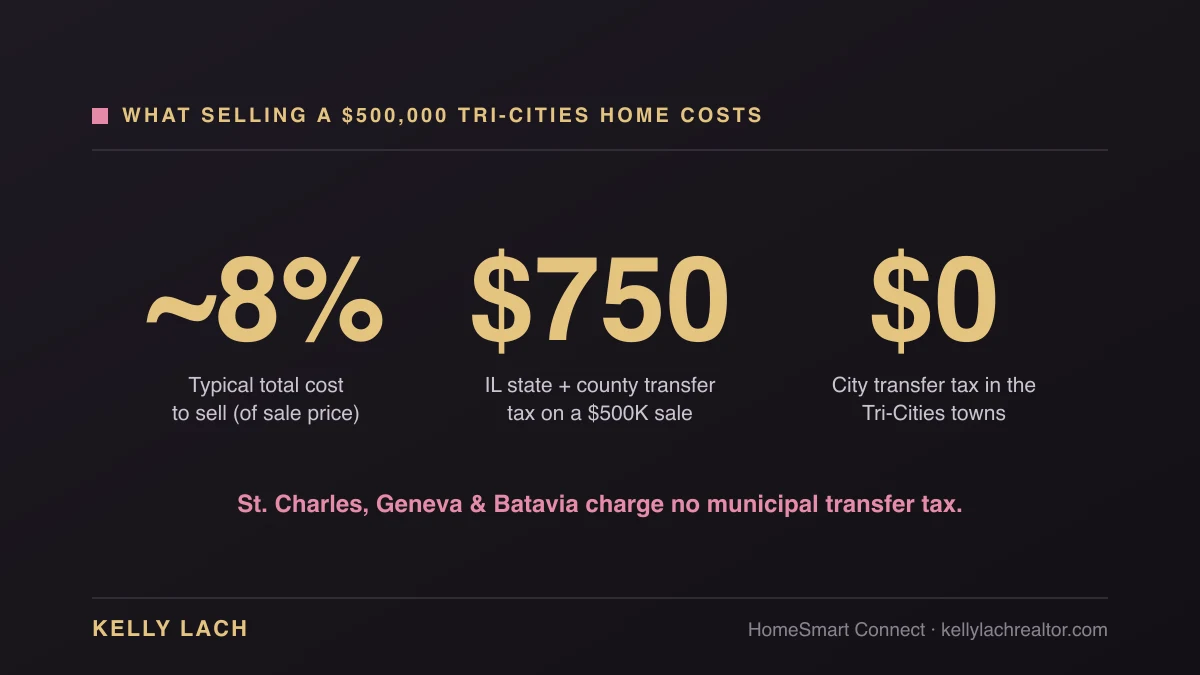
Illinois charges a state real estate transfer tax of $0.50 per $500 of the sale price, and Kane County adds $0.25 per $500. Combined, that is $1.50 per $1,000, or 0.15% of the price, and in Illinois the seller pays it. On a $500,000 sale that is $750 total.
Here is the good news for Tri-Cities sellers: many Chicago-area towns are home-rule and pile on their own municipal transfer tax (sometimes $3–$10 per $1,000). St. Charles, Geneva and Batavia do not. St. Charles does not even require a transfer stamp. So in the Tri-Cities your transfer-tax bill stops at the state and county line — a few hundred dollars, not a few thousand.
This is the line that catches sellers off guard. Illinois property taxes are paid about a year in arrears — the bill you pay this year is for last year. When you sell, you have lived in the home for part of the current year but have not yet been billed for it, so at closing you credit the buyer for all of the taxes that accrued while you owned the home but have not yet come due.
Kane County tax bills on a mid-priced St. Charles home often run $8,000–$13,000 a year. Depending on your closing date and whether the prior-year bill has been paid, your proration credit can easily be several thousand dollars — sometimes more than a full year’s tax. It is not an extra fee; it is money you genuinely owe for the time you owned the home. Your attorney calculates the exact figure at closing, usually using a proration factor (commonly 100–110% of the last known bill).
Put it together on a $500,000 St. Charles sale with a $250,000 mortgage payoff. This is illustrative — your real number depends on your loan balance, closing date and tax bill — but it shows the shape of a typical Tri-Cities close.
| Line | Amount |
|---|---|
| Sale price | $500,000 |
| Less commission (about 5%) | − $25,000 |
| Less state + county transfer tax | − $750 |
| Less attorney | − $750 |
| Less owner’s title + closing fees | − $2,600 |
| Less prep, staging & repairs | − $3,000 |
| Less property-tax proration credit | − $6,000 |
| Less mortgage payoff | − $250,000 |
| Estimated net to seller | ≈ $211,900 |
Kelly’s honest take: the two numbers that actually move your bottom line are the sale price and the commission conversation — the taxes and attorney fees are small and fixed. The real money is made by pricing the home right and marketing it hard so it sells for more, and by understanding your tax proration before you sign so there are no surprises at the closing table. Everything else on this list is a few hundred to a few thousand dollars.
Want a real number for your home instead of an example? A local agent can build a net-sheet on your exact address in a few minutes. You can get a home valuation and selling plan from a Tri-Cities listing agent or see what is happening in the St. Charles market right now. Curious about the area itself? Read our St. Charles neighborhood and market guide.
Get a free, no-pressure home valuation and a line-by-line net sheet for your Tri-Cities home.