

Selling the home you have lived in for decades means closing a tax chapter as well as a house chapter. The senior exemption when you sell your house Illinois owners ask about is not a benefit you carry in your pocket. It belongs to a property and an owner who lives there, and the sale ends it. Most pages about senior exemptions explain how a current owner signs up. This one is written for the person about to sell.
It is a realtor’s explanation, not tax advice, and the county and the state own the rules. If you are weighing a move, our downsizing sale planning page explains how we plan a sale from the first conversation.
Most long-time owners have more than one of these on the bill, and few can name them. Write down which ones you receive before you speak to anyone. The Illinois Department of Revenue lists the programs on its property tax relief page, and that page is also where current amounts and income limits are posted. They change, so this guide leaves the numbers to the state.
| Program | What it does, in general terms | Where it stands in the sale |
|---|---|---|
| General homestead exemption | Reduces the taxable value of an owner-occupied principal residence | Ends on the house you sell |
| Senior citizen homestead exemption | An additional reduction for an owner who is 65 or older | Ends on the house you sell |
| Senior assessment freeze | Holds the assessment at a base year for qualifying owners with income under the program limit | Tied to the property and the owner, so ask the assessor how it applies at a new home |
| Senior tax deferral | Lets a qualifying owner defer property tax with a lien on the home | The state recovers the deferred amount when the property is sold |
The Kane County Supervisor of Assessments describes each one on its homestead exemptions page, with a separate page for each exemption and the application route.
The county says homestead exemptions are typically available to properties occupied by their owners as of January 1 of the taxable year. The senior exemption adds that the owner must be 65 or older by the end of the assessment year, and the county page for the general exemption says the property must be the principal residence of the owner. Put together, the logic is simple: the exemption depends on who owns and lives in the home, and once that person sells and moves, the benefit does not stay behind for the buyer.
Two things to ask before you list:
The year of sale is also split between you and the buyer at closing, which is a separate topic from exemptions. Our guide to what it costs to sell a house in Illinois walks through how those closing adjustments work.
If the house came through an estate and is sitting empty, what a vacant house means for insurance during probate covers the insurance side.
The tax figure on your listing usually reflects your exemptions. The next owner starts from their own situation, and a buyer who is under 65 or who has not yet filed for anything is not going to see a bill with your reductions in it. That is not a flaw in the listing. It is the reason buyers are told to pull the parcel’s bill and read it with their own agent, and the reason a sharp buyer’s agent will ask about it.
If you are the seller, this works in your favor to understand. You can explain to buyers, honestly and early, that the listed tax line is built on the current owner’s exemptions and that their own bill will differ. Our step-by-step guide to selling a house in Illinois covers the other pieces of the listing conversation.
You start over with the county where the new home sits. In Kane County, the Supervisor of Assessments takes applications for the general and senior exemptions, now through an online exemption portal, and the office will mail a form if you call. For the senior assessment freeze, the county says a property must be the principal residence of the owner for the beginning of two consecutive years, and that the owner must be 65 or older and meet the household income rules. Read that sentence twice if you are moving, and ask the office how it applies when the home is new to you.
On the buying side, the exemptions a new owner in Kane County claims after closing covers what a buyer applies for once the home is theirs.
Timing matters because of the January 1 occupancy date. A move late in the year and a move early in the next year can land on opposite sides of that date. The office can tell you which side of it you will be on, and you can plan the closing with that in mind. If your new home is in Kane County, the same office handles it.
The exemptions depend on owning and living in a principal residence, so a different housing arrangement changes the answer. If you move into a rental, there is no property tax bill in your name to reduce. If you buy a condominium or townhome, you are an owner and apply like any other. The county notes that exemptions may also be available for cooperatives and qualified life-care facilities, and recommends contacting the assessment office for those. When the structure is unusual, call the office before you sign.
Use this as a conversation guide with your attorney, the assessor and your agent. It does not list amounts, because every parcel and every household is different.
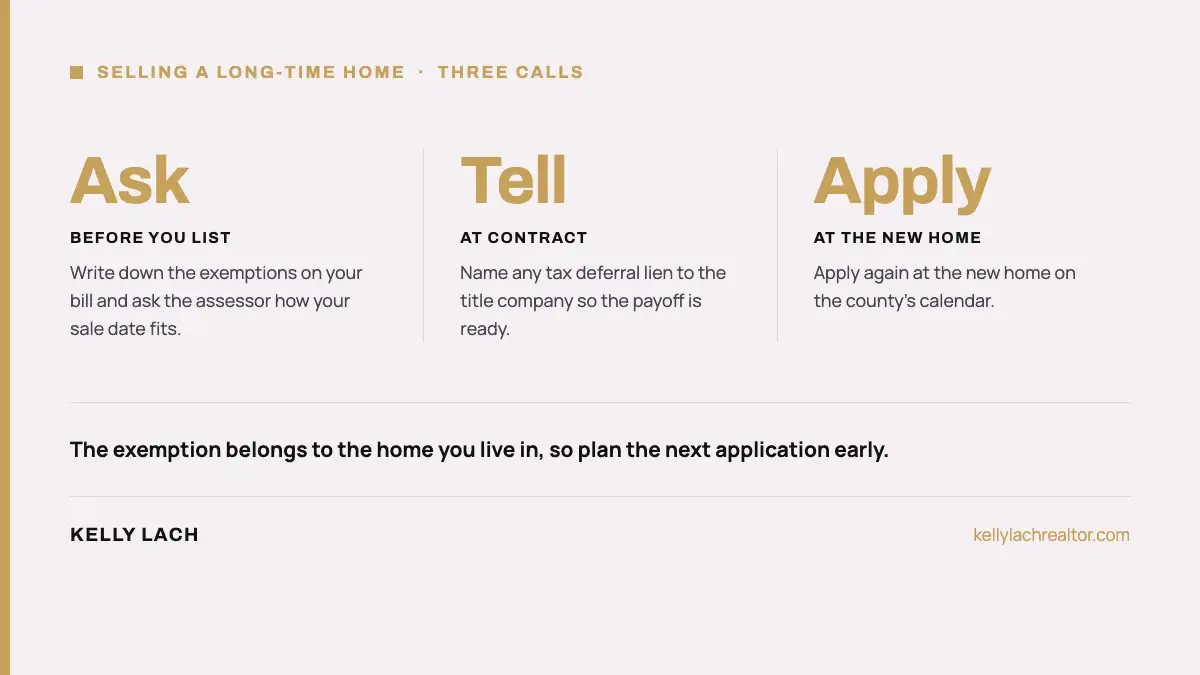
| When | What to do |
|---|---|
| Before listing | List the exemptions on your bill, note any tax deferral lien and ask the assessor how your sale date affects the year |
| At contract | Tell your attorney and the title company about any deferral lien, and confirm the closing date against the January 1 date |
| At closing | Check the proration of the year’s tax on the closing statement, and confirm the new mailing address with the county |
| First year in the new home | File for the exemptions you qualify for and calendar each renewal |
The blunt version: every page on this topic tells a current owner how to sign up. Almost none tells the person about to sell what they are giving up and how to ask for it back. Call the assessor before you list, write down what is on your bill, and plan the closing date around the county’s January 1 occupancy date.
If you are moving into a 55+ community, timing the closing around that community covers how the two dates fit together.
The senior exemption when you sell your house Illinois sellers face is one of the easiest things to overlook and one of the easiest to plan for. If you want a local agent to line up the sale with your timeline, a short conversation about your plans is the place to start.
Kelly Lach is a Top 3% agent and St. Charles resident who helps sellers plan the sale of a long-time home across St. Charles, Geneva and Batavia. Call 630-674-0424.