

The property tax bill first year after buying Illinois homes arrives is the one most buyers misread, because the number they saw on the listing felt like a promise. It is not. It is last year’s bill for the previous owner. This guide explains how to read that line before you make an offer, and what changes once the house is yours.
It is a realtor’s explanation, not tax advice, and Kane County’s offices own the figures. If you are still searching, homes for sale in Kane County is where the listing pages live, and each one shows a tax line worth reading with this guide open.
Three questions turn that single number into useful information.
Ask your agent for the parcel number, pull the bill, and compare it to the listing. If they differ, ask why before you rely on either.
Illinois bills property taxes in arrears. The county’s own answer to a buyer who closed mid-year and wonders why a full year of tax is due is that taxes are paid one year in arrears, and that the property is what is taxed, not the individual. In plain terms, the bill you receive after you buy is for the year before.
| Step | What happens | When, in general terms |
|---|---|---|
| Assessment date | The township assessor values the property as of January 1 of the assessment year | January of the tax year |
| Assessment notices | Changes are published by township, with a filing deadline for complaints | Summer, township by township; the county posts each one |
| Bills are mailed | The Treasurer mails bills for that tax year | The year after the assessment year |
| First installment | The first installment of the bill is due | The date printed on your bill |
| Second installment | The remaining installment is due | The date printed on your bill |
The exact dates change each year and are printed on the bill and posted on the Treasurer’s site. Use those, not a rule of thumb from an article, including this one.
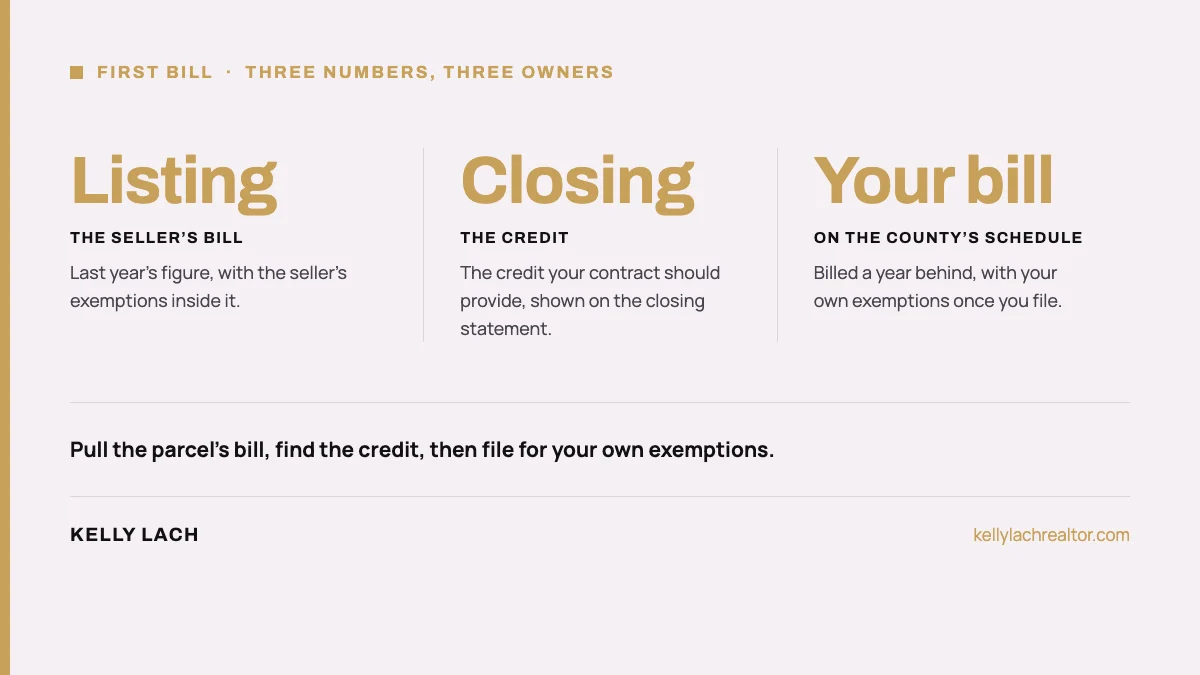
Because the previous year is still unpaid when you close, the usual arrangement is a prorated credit for the seller’s share, written into your contract. The Kane County Treasurer’s FAQ says the taxes should have been discussed before closing, and the agreement is noted on the closing statement as a prorated tax credit. Confirm yours with your attorney.
Three things to do with that line:
The seller’s side of this credit, along with the other costs of a sale, is in what it really costs to sell a house in Illinois. From the buyer’s chair, the only job is confirming the credit your contract should provide appears on the closing statement.
The listing figure carried the seller’s exemptions, and your bill carries yours. Kane County describes homestead exemptions as reductions in taxable value that are typically available for properties occupied by their owners as of January 1 of the taxable year. That has two practical effects for a buyer:
The assessment is a separate input. The township assessor estimates the property’s fair cash value and builds the assessment from it, using the three prior years of sales in the area. A sale, including yours, is one of the data points that feeds later valuations. That is a mechanism, not a prediction, and we do not forecast anyone’s bill here.
The Kane County Supervisor of Assessments lists the homestead exemptions, the forms and the contacts. The Illinois Department of Revenue also summarizes property tax relief programs at the state level.
If you are a first-time buyer, this is one of the steps people miss because nothing about closing prompts it. Our first-time home buyer guide for St. Charles puts it alongside the other post-closing items.
Kane County assessments are built by township. According to the Supervisor of Assessments FAQ, you start by talking with the township assessor, and if that does not resolve it, the next step is a complaint to the Board of Review. St. Charles, Geneva and Batavia each have their own township assessor listed on that FAQ page.
The clock is short. The Supervisor of Assessments posts each township’s newspaper publication and its final filing deadline on the county site, so check it as soon as you receive a notice. Never rely on a date from an article, because the deadlines are set township by township every year.
For a house in the river towns, the guides to living in Geneva and living in Batavia are good companions to this one, because the town you buy in changes which assessor and which taxing districts appear on your bill.
If your lender collects taxes in escrow, it pays the county on your behalf, usually from the amount on the Treasurer’s bill. The Treasurer’s FAQ is clear that a lender that pays late is responsible for the penalties from its own account. Your job is to make sure its numbers start in the right place.
No dollar figure belongs in this plan, because every parcel is different. The right number is the one on the county’s bill for your parcel.
The blunt version: the most misread number on an Illinois listing is the tax line, and nearly every page about it is written for an owner fighting a bill or a lawyer reading a statute. A buyer in Batavia needs something simpler. Pull the parcel’s bill, find the credit at closing, file for your own exemptions and know where your township posts its deadline.
The property tax bill first year after buying Illinois property is not a surprise if you read the listing figure the right way. If you want a local agent to pull the parcel records with you before you write an offer, a short conversation about your timeline is the place to start.
Kelly Lach is a Top 3% agent and St. Charles resident who walks buyers through the closing credit and the first bill across St. Charles, Geneva and Batavia. Call 630-674-0424.
Buying along the Fox River adds a second line item to budget for. Read what to check on a Fox River flood plain home before the tax bill is the only number you are modelling.