

The deposit is the first money a buyer puts at risk, and most buyers learn the rules only when something goes wrong. People type earnest money illinois who holds it into a search bar and get answers written for a national audience that stop at “it depends.” Who holds the deposit, and when it comes back, is answered by your contract more than by any general rule. This guide shows a Tri-Cities buyer which lines of the contract to read, in what order.
It is a realtor’s walk-through, not legal advice. Your attorney reads the contract and decides what it means for you. If you are still choosing who will help you buy, a first-time home buyer agent in St. Charles, Geneva and Batavia can walk you through the whole sequence, and our guide to the buyer agency agreement in Illinois covers the paperwork that comes before an offer.
The contract names the holder. Read the earnest money paragraph and write down three things: who holds the deposit, when it is due and what the holder is told to do with it. In an Illinois purchase the holder is often one of these:
When a licensed broker holds the money, Illinois law sets the handling. Section 1-10 of the Real Estate License Act defines escrow moneys to include earnest moneys. Section 20-20 makes failing to keep them in a special account, separate from the broker’s personal and other business accounts, a ground for discipline, and it describes when the money can leave the account: on the written direction of the parties, under directions in a signed contract, or under a court order. You can read the text of 225 ILCS 454/20-20 on the state’s own site, and the Illinois Department of Financial and Professional Regulation, which licenses brokers, is at idfpr.illinois.gov.
That one rule explains most of what follows. The holder generally follows the contract and the signatures instead of deciding who is right.
The contract states a deadline for delivering the deposit, often counted from the date the contract is signed. Missing it can put you in breach before the deal has really started, so do not leave it for the last hour. Ask the holder for written confirmation that the money arrived, and keep that email with the contract.
Use a short timeline. Fill in the real dates from your contract the day you sign.
| Step | What to find in the contract | What to do |
|---|---|---|
| Contract signed | The date the deposit is due and who receives it | Wire or deliver on time, then get written receipt |
| Attorney review | The number of days each side’s attorney has to review and propose changes | Put your attorney on the thread the first day |
| Inspection window | The deadline to inspect and to send a written request or notice | Book the inspector the day you sign, not the week after |
| Mortgage contingency | The date by which you must have loan approval or give notice | Ask your lender for the dates they can actually meet |
| Appraisal | What happens if the value comes in short and by when you must respond | Ask your agent and attorney before the appraisal, not after |
| Closing | How the deposit is applied at the table | Confirm the credit on the closing statement |
A contingency is a condition written into the contract that lets you leave or renegotiate if it is not met. The deposit is protected only while the contingency is alive, so each deadline is also a deadline for your money. The ones you will meet in most Illinois purchases are:
The wording differs from one contract to the next, so the dates and steps in yours control. Never assume a deadline is flexible because the other side was friendly about it. Ask for any extension in writing, signed by both parties.
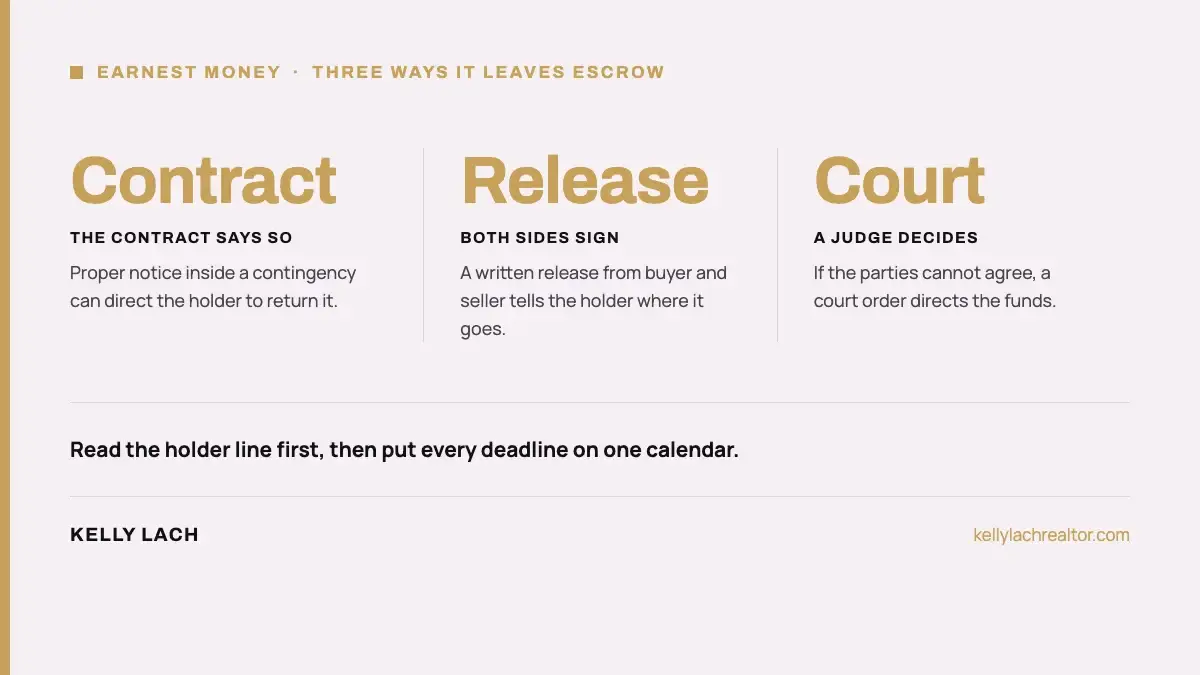
There are three ordinary ways a deposit is released. When a broker holds the money the statute above allows all three, and a title company or attorney will follow the contract the same way.
What if the other side will not sign the release? Do not argue with the holder, and do not stop answering messages. Hand the file to your attorney, keep your notice and every dated email, and ask your attorney what the holder’s next step will be, because the holder may keep the money in escrow until the parties agree or a court decides. A missed date can mean a wait, a dispute over who keeps the deposit or losing it, which is why the dates matter.
The blunt version: every page that ranks for this question says the answer depends on your contract, and then stops. The useful part is the order of the contract lines to read: holder, due date, contingencies, notice method, release. Do that on day one and earnest money in Illinois stops being a mystery and becomes a calendar.
This is a working list for the first two weeks under contract in St. Charles, Geneva or Batavia. Adjust it with your attorney and lender.
| When | What to do | Who helps |
|---|---|---|
| Day one | Read the earnest money paragraph, note the holder and the due date, and send the deposit by the method the contract names | Your attorney, your agent |
| Day one | Confirm wiring instructions by phone, then get written proof the money arrived | The holder |
| Day two | Put every contingency deadline on your calendar with a reminder two days earlier | You, your agent |
| Week one | Complete the inspection and talk with your attorney about any written notice before the deadline | Inspector, attorney |
| Week two | Ask your lender where the loan approval stands against the mortgage date | Your lender |
If you are weighing a town before you make an offer, the homes for sale in Kane County page shows what is on the market now, and our first-time buyer guide for St. Charles covers the local steps in order. When the contract is in front of you, a short conversation about your timeline is the place to start, and it helps to have the dates in hand.
Kelly Lach is a Top 3% agent and St. Charles resident who helps buyers across St. Charles, Geneva and Batavia plan the steps between an accepted offer and the closing table. Call 630-674-0424.