

Closing day does not usually come with a prompt to file for a tax exemption, so some buyers first hear about it when the first bill arrives. If you searched for the Kane County homestead exemption after buying, you probably found the county’s own forms, which explain each exemption well but do not say when in a closing timeline to deal with them. This guide puts the steps in order for a buyer in St. Charles, Geneva or Batavia, starting from the moment you tour homes for sale in Kane County.
It is a realtor’s walk-through, not tax advice. The Kane County Supervisor of Assessments owns the rules and the forms, and your attorney or tax adviser can say how they fit your situation.
The tax line on a listing is usually the previous bill, and it reflects the exemptions the seller was claiming. Our guide to your first Illinois property tax bill after buying explains how that figure is built and what happens to it at closing. This post picks up the exemption piece on its own, because it is the one part of the bill you control.
The Supervisor of Assessments lists the homestead exemptions on its exemptions page. The county describes them as reducing the taxable value of a property before taxes are calculated, and says they are typically available for properties occupied by their owners as of January 1 of the taxable year. For a new owner, these are the ones worth reading:
The county site states the current amounts and the income limits, and they change, so read them there instead of in an article. If an owner of the home will be 65 or older by December 31 of the tax year, or you are planning an addition, ask the office about those two lines before you close.
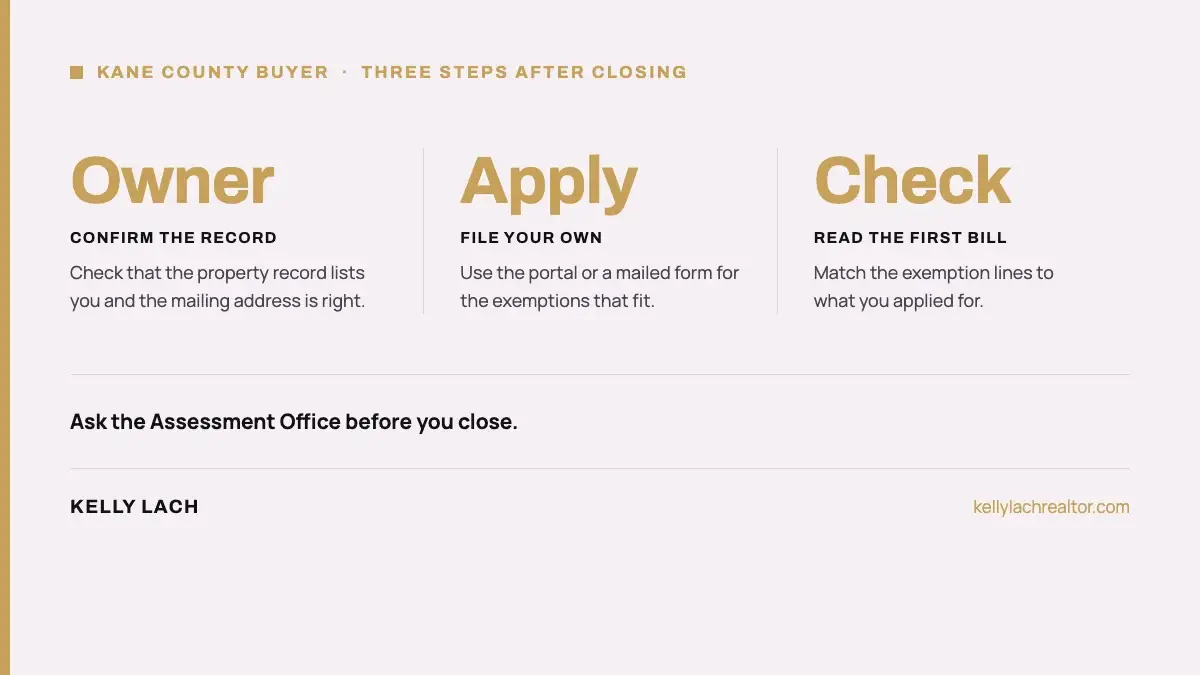
Three questions are worth asking the Assessment Office before you close, because the answers shape everything after:
Write down the answers with the date you asked and the name of the person who answered, since the county’s pages remain the authority.
The county’s wording ties these exemptions to who occupies the home as of January 1 of the taxable year. It does not publish a new-owner calendar, so the useful move is to match your own dates against that test and ask the office about any date that falls on the wrong side. This table is a way to organize the question, not a ruling.
| Where your dates fall | What the county’s pages say | What to do |
|---|---|---|
| You closed and moved in before January 1 | You are the owner-occupant the January 1 test looks for | Apply as soon as you hold the keys |
| Your closing is after January 1 | The test refers to January 1 of the taxable year, and the pages do not describe a split year | Ask the Assessment Office how the year of your closing is handled, and ask your attorney how the closing statement treats it |
| You will rent the home out or not live there | Each exemption is tied to a principal residence | Ask the office what applies before you assume anything |
| Closing is still weeks away | The online portal and mailed forms are both available | Make the account in the portal now so the application is ready |
For the General Homestead and Senior Citizen exemptions, the county says you apply with the County Assessment Office. It has an online exemption portal, where a first-time user creates an account, and it will also mail a form if you call. The page for each exemption lists the requirements and the state law behind it, so the form you need is the one on that page.
Before you apply, confirm that the property record shows you as the owner and that your mailing address is right. The county’s property tax FAQ lists a missing exemption as the first reason a bill goes up, which is a fair reason to check the exemption lines on your first bill against what you applied for. The Kane County Treasurer has a property tax lookup and a way to print a bill for your parcel.
This is where buyers get tripped, because the answers differ by exemption:
If your plans change later, such as moving out or renting the home, ask the Supervisor of Assessments what to tell them. The exemptions follow the principal residence, so a change in how you use the home is a question for the office.
The blunt version: the county explains each form, and nobody tells a buyer when in the closing timeline to file one. Put the owner record, the portal account and the exemption questions on the calendar before closing day, and the Kane County homestead exemption after buying becomes a task you finish instead of a surprise on the first bill.
| When | What to do | Who helps |
|---|---|---|
| Before closing | Ask the Assessment Office which exemptions fit your household and how your closing date interacts with the January 1 test | Supervisor of Assessments, your agent |
| Week one | Confirm the property record lists you as the owner and the mailing address is correct | You, the Assessment Office |
| Weeks two to four | Apply for the exemptions that fit through the portal or by mailed form | You |
| When your township notice arrives | Read it, and if the value looks wrong, call the township assessor first | Township assessor |
| When the first bill arrives | Check the exemption lines against what you applied for, and note any renewal date in your calendar | Treasurer, Assessment Office |
If you are still choosing a town, our guides to living in Geneva and living in Batavia show how the river towns differ, since the town you buy in decides which township assessor and taxing districts appear on your bill, and you can see what is on the market now across Kane County homes for sale. First-time buyers can find the whole sequence in our first-time home buyer guide for St. Charles, and a short conversation about your timeline is a good place to start.
Kelly Lach is a Top 3% agent and St. Charles resident who helps buyers across St. Charles, Geneva and Batavia plan the steps between an accepted offer and the first tax bill. Call 630-674-0424.